
| Exam Code | CCAR-P |
| Exam Name | Claude Certified Architect Professional |
| Vendor | Anthropic |
| Total Questions | 200 |
| Last Updated | 26-Oct, 2026 |
- Latest & Verified Questions
- Detailed Explanations
- Regular Updates
- Full-Length Practice Tests
- Boost Your Exam Confidence
PDF Study Materials
Downloadable guides and resources
Practice Tests
Full-length tests with real exam experience
Progress Tracking
Monitor your performance and improvement
Study Anywhere
Access on desktop, tablet, and mobile
Free CCAR-P Practice Questions
Explore 14 free practice questions for the Anthropic CCAR-P exam and review the answers and explanations to support your preparation.
-
Question 1
Single answerYou are transitioning a Claude-based deployment from design into implementation.
Which handoff package most directly supports a clean transition?
-
Option A:Correct
The most recent set of design presentation slides without component-level diagrams, interface contracts, an evaluation framework with a reference set, runbooks, or a known-limitations register.
-
Option B:Correct
A verbal walkthrough conducted on the day of handoff with no written architecture overview, ADRs, component contracts, evaluation framework, runbooks, playbook, or known limitations.
-
Option C:Correct
Architecture overview, ADRs, component contracts, evaluation framework with reference set, runbooks, on-call playbook, and known limitations.
-
Option D:Correct
Source code alone with no integrating architecture overview, ADRs, component contracts, evaluation framework, runbooks, on-call playbook, or known-limitations register to support the delivery team.
Show Answer & Explanation Hide Answer & Explanation
Correct Answer: C
Explanation
Option C provides the minimum coherent package required to move from architectural intent to implementable and supportable delivery. The architecture overview establishes system boundaries and component relationships. Architecture Decision Records preserve the context and trade-offs behind key choices. Component contracts define interfaces, schemas, responsibilities, failure behavior, and integration assumptions.
The evaluation framework and reference set allow the implementation team to confirm that prompts, models, retrieval components, and tool integrations continue to meet the defined quality, safety, latency, and cost thresholds. Runbooks translate operational knowledge into repeatable procedures, while the on-call playbook defines detection, escalation, containment, and recovery actions. The known-limitations register prevents unsupported behavior from being mistaken for an implementation defect and helps stakeholders manage residual risk.
Options A and B depend excessively on slides or undocumented verbal knowledge. Option D provides implementation material without explaining the system-level decisions, operating model, acceptance criteria, or limitations. Source code cannot substitute for architectural and operational documentation.
A clean transition does not mean the architect can never be consulted. It means routine implementation and support do not depend on undocumented knowledge held by a single individual.
Study Guide references/topics: Design-to-implementation handoff; ADRs; component contracts; reference evaluations; runbooks; operational playbooks; limitations management.
===============
-
-
Question 2
Single answerA business sponsor has requested an AI solution to “improve customer experience.” The sponsor cannot articulate which customer journey is failing, which metric reflects the failure, or which decisions the AI should support. The sponsor is asking you to begin design work next week.
Which delegation-competency action should you take first?
-
Option A:Correct
Recommend that the sponsor revise the request and resubmit it later for evaluation.
-
Option B:Correct
Begin prototyping a generic assistant against the broad request before the next deadline.
-
Option C:Correct
Propose a fixed scope that you commit to by default based on your own assumptions.
-
Option D:Correct
Facilitate a structured discovery to define the failing decision and the target metric.
Show Answer & Explanation Hide Answer & Explanation
Correct Answer: D
Explanation
The request is not yet design-ready because it lacks a defined failure, affected user journey, supported decision, target population, and measurable outcome. The architect should therefore facilitate structured discovery rather than prematurely selecting an AI pattern or model.Discovery should identify where the current customer journey breaks down, who experiences the problem, what decision or task requires assistance, what data is available, and which metric would demonstrate improvement. The team can then establish baseline performance, target thresholds, operational constraints, risks, and explicit non-goals. Anthropic’s evaluation guidance states that an LLM application should begin with clearly defined success criteria and a method for measuring them. Define Success Criteria and Build EvaluationsOption A abandons the sponsor instead of helping translate a business concern into an actionable problem. Option B risks producing a generic demonstration unrelated to a validated customer need. Option C substitutes the architect’s assumptions for stakeholder evidence and may commit the organization to the wrong scope.Competent delegation begins by defining the decision, intended outcome, authority boundaries, and target metric before determining which responsibilities should be assigned to Claude, conventional software, or human reviewers.Study Guide references/topics: Structured discovery; delegation competency; problem definition; target metrics; decision support; measurable business outcomes.=============== -
-
Question 3
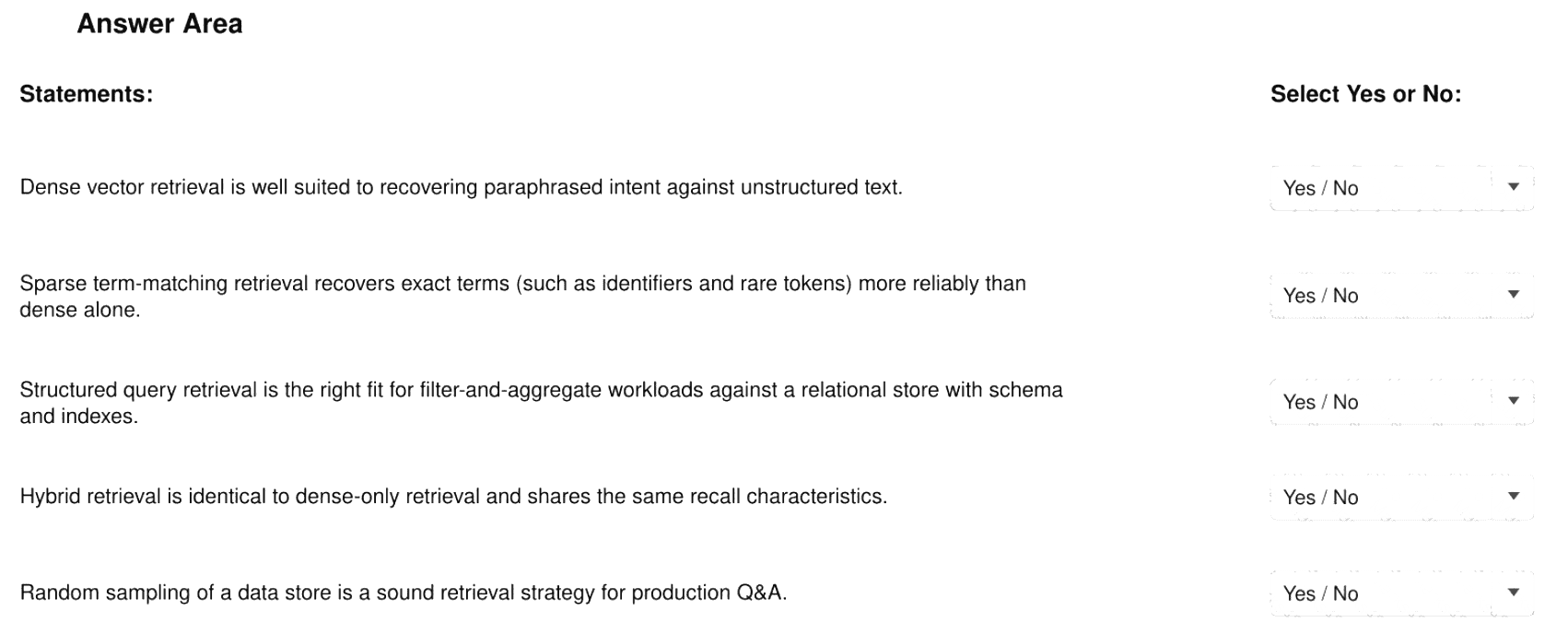
Drag & DropYou are evaluating retrieval-strategy claims used by a peer team.
For each claim, select yes if the statement is generally accurate. Otherwise, select no.
Show Answer & Explanation Hide Answer & Explanation
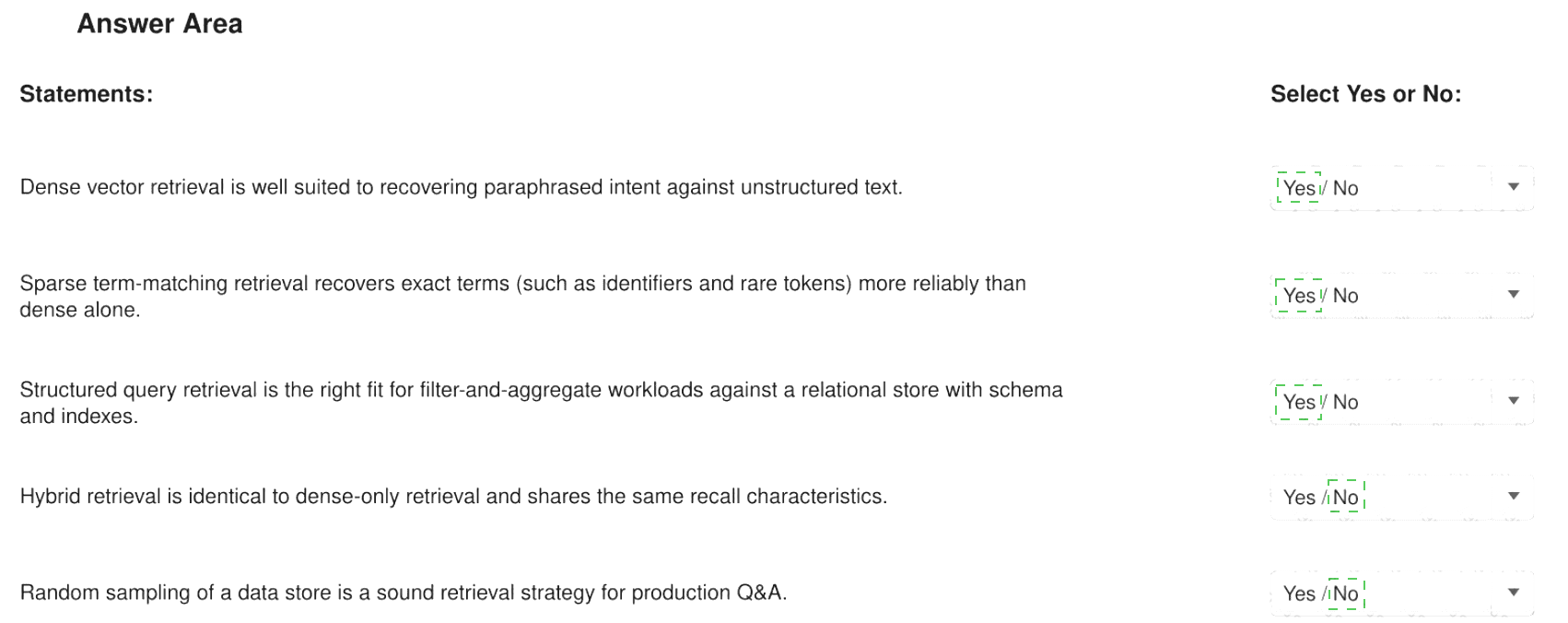
Correct Answer
Explanation
Yes, Yes, Yes, No, No
Dense vector retrieval represents semantic similarity, making it suitable for matching paraphrases and conceptually related language even when the query and source do not share identical words. Sparse lexical retrieval, including BM25-style matching, retains strong sensitivity to exact tokens and is therefore valuable for identifiers, product codes, technical names, and uncommon terminology.
Structured query retrieval is appropriate when the required operation depends on explicit fields, predicates, joins, counts, grouping, or aggregation over a relational schema. In that situation, generating or invoking a constrained database query is more precise than approximating the operation through semantic similarity.
Hybrid retrieval is not identical to dense retrieval. It combines semantic and lexical candidate sets, typically followed by rank fusion or reranking. Anthropic’s contextual-retrieval guidance explains that semantic search captures meaning and paraphrases, while BM25 captures exact terminology; combining them improves coverage. Contextual Retrieval, Contextual Retrieval Cookbook
Random sampling is not a relevance strategy. It provides no systematic relationship between the query and selected evidence, producing unstable coverage and preventable hallucination risk. Production Q & A requires deterministic or evaluated relevance mechanisms, access filters, suitable indexes, and measurable retrieval metrics such as recall at k.
Study Guide references/topics: Dense retrieval; sparse retrieval; structured queries; hybrid search; rank fusion; retrieval evaluation; production RAG design.
===============
-
Question 4
Multiple answersYou are building an ethics-review checklist for deployments supported by artificial intelligence.
Which two checks belong on the list? (Select two.)
Each correct answer presents a complete solution.
-
Option A:Correct
Confirm that vendor licensing terms permit the planned production use of the model.
-
Option B:Correct
Verify that outputs do not rely on generalizations about people that the underlying data does not support.
-
Option C:Correct
Confirm that high-impact decisions retain human accountability rather than being attributed to the model.
-
Option D:Correct
Restrict ethics review to outputs that exceed a defined model-confidence threshold.
-
Option E:Correct
Show Answer & Explanation Hide Answer & Explanation
Correct Answer: B, C
Explanation
An ethics review must examine unsupported generalizations, stereotyping, disparate treatment, and other conclusions about people that are not justified by the evidence. It must also preserve identifiable human accountability for consequential decisions; responsibility cannot be transferred to a probabilistic system. Licensing is a legal and commercial-control question, while latency and throughput are operational requirements. Both remain important, but neither is the central ethical test presented here. Restricting review to low-confidence or threshold-triggering outputs is also inadequate because models can express harmful or biased conclusions with high confidence. Ethical review should cover representative populations, protected and intersectional groups, high-impact outcomes, override mechanisms, transparency, and channels for challenge or appeal.
Study Guide references/topics: Bias and unsupported generalization; human accountability; consequential decisions; ethical oversight.
-
-
Question 5
Multiple answersA Claude architect is auditing configuration scope assignments.
Which two statements correctly identify an appropriate use of user-scope configuration versus other scopes? (Select two.)
-
Option A:Correct
Persisting personal editor theme preferences that follow an engineer across projects.
-
Option B:Correct
Saving a preferred Claude response language that applies to all repositories the engineer uses.
-
Option C:Correct
Enforcing a company-wide policy that disables a feature for all engineers.
-
Option D:Correct
Defining MCP server endpoints shared by all contributors to a specific repository.
-
Option E:Correct
Show Answer & Explanation Hide Answer & Explanation
Correct Answer: A, B
Explanation
User scope applies to one engineer across every project and is therefore appropriate for portable personal preferences. Option A fits this definition because an interface theme belongs to the individual rather than to a repository or organization. Option B also fits because Claude Code provides a language setting for the preferred response language, and placing that preference in user scope makes it apply across repositories.
Option C requires managed configuration because an organization-wide security control must be centrally deployed and resistant to individual override. Option D belongs in project scope because repository-specific MCP endpoints must be shared consistently with that repository’s contributors.
Option E describes credential handling rather than merely a preference assignment. Credentials must not be placed in a repository, but avoiding version control alone is insufficient. They must be stored through a supported secure authentication mechanism, protected environment configuration, operating-system credential facility, or approved secrets manager—not inserted as plaintext into an ordinary settings file.
Anthropic defines user scope as affecting one user across all projects, project scope as shared repository configuration, and managed scope as the location for enforceable organizational controls. It also explicitly lists themes and other personal settings as user-scope use cases. Claude Code Configuration Scopes
Study Guide references/topics: User scope; project scope; managed configuration; personal preferences; repository-shared MCP configuration; credential protection.
===============
-
-
Question 6
Multiple answersA technical team is cataloguing risks specific to Claude’s use in a document-grounded Q & A system.
Which two items represent failure modes intrinsic to LLM-based systems rather than generic software defects? (Select two.)
-
Option A:Correct
An expired TLS certificate blocks outbound API calls to Claude.
-
Option B:Correct
A database connection timeout causes retrieval to return an empty result set.
-
Option C:Correct
The model refuses a legitimate query because surface features trigger an overly broad safety pattern.
-
Option D:Correct
A misconfigured load balancer routes requests to a deprecated API version.
-
Option E:Correct
Show Answer & Explanation Hide Answer & Explanation
Correct Answer: C, E
Explanation
Over-refusal and hallucination are characteristic model-behavior risks. An overly broad safety response can reject a legitimate request even when the surrounding application operates correctly. A plausible but unsupported answer is a groundedness failure arising from probabilistic generation and inadequate source adherence. These risks require model-specific evaluations, grounding instructions, citations, verification, and calibrated fallback behavior. Expired certificates, database timeouts, and load-balancer misconfiguration are conventional distributed-system failures that should be addressed through infrastructure monitoring, retries, health checks, and configuration management. Distinguishing these categories matters because ordinary software remediation will not resolve behavioral failures, while prompt changes will not repair infrastructure. Anthropic’s hallucination guidance recommends auditable citations and supporting evidence for generated claims. Reducing hallucinations
-
-
Question 7
Multiple answersThe compliance team at a firm has approved a Claude Skill that generates client-facing investment summaries. The Skill includes the firm’s required disclaimers and prohibited-language list. A product manager has asked whether additional guardrails are needed at the application layer or whether the Skill alone is sufficient.
Which two guardrail responsibilities should remain at the application layer rather than the Skill? (Select two.)
Each correct answer presents part of the solution.
-
Option A:Correct
Log every generated summary to the firm’s compliance audit trail for retention.
-
Option B:Correct
Verify the requesting user is authorized to generate investment summaries at all.
-
Option C:Correct
Format output sections according to the firm’s standardized house style guidelines.
-
Option D:Correct
Apply the disclaimer template that the compliance team has standardized firm-wide.
-
Option E:Correct
Show Answer & Explanation Hide Answer & Explanation
Correct Answer: A, B
Explanation
Authorization and compliance logging must remain enforceable application-layer controls. Option B requires the application to authenticate the requester, resolve the user’s role and entitlements, and deny the operation when the user lacks authority. A Skill can instruct Claude how to behave, but it is not a reliable security boundary and cannot replace identity-based access control enforced by the surrounding system.
Option A similarly belongs at the application layer. The application must create an authoritative audit event containing the requester, timestamp, Skill and model version, relevant input or content identifiers, generated output, review status, and retention classification. Audit evidence cannot depend on whether the model remembers or chooses to invoke a logging instruction.
Options C, D, and E describe reusable generation behavior that appropriately belongs within the approved Skill: house style, the standardized disclaimer, and the prohibited-language policy. The application may still validate their presence after generation, but the Skill remains the primary reusable content package.
The correct architecture separates behavioral guidance from deterministic enforcement. Skills supply domain instructions and templates; the application enforces identity, authorization, audit retention, data access, output validation, and consequential-action controls.
Study Guide references/topics: Skills versus application controls; authentication; authorization; compliance logging; deterministic guardrails; policy enforcement boundaries.
===============
-
-
Question 8
Multiple answersA Claude architect is designing a HIPAA-compliant pipeline that processes patient records.
Which two design decisions directly support HIPAA compliance requirements? (Select two.)
-
Option A:Correct
Setting max_tokens to a low value to minimize the volume of text generated per request.
-
Option B:Correct
Selecting the highest-capability Claude model to maximize diagnostic accuracy.
-
Option C:Correct
Enforcing role-based access controls so that PHI is retrievable only by authorized personnel.
-
Option D:Correct
Ensuring patient data is never included in training feedback loops sent to the model provider without a BAA in place.
-
Option E:Correct
Show Answer & Explanation Hide Answer & Explanation
Correct Answer: C, D
Explanation
Role-based access control directly supports HIPAA’s access-control and minimum-necessary principles. The retrieval and orchestration layers must verify the authenticated user’s role before protected health information enters the model context. Authorization should be applied to individual records, data sources, tools, and actions, with audit events recording the requesting identity, accessed resource, purpose, and result. Model instructions alone are not a security boundary.
Patient information must also remain within services and processing activities covered by the organization’s Business Associate Agreement. Anthropic states that PHI processing requires a HIPAA-ready organization and an accepted BAA, and that only specified eligible services and configurations are covered. Patient data must not be submitted through training, feedback, beta, third-party, or integration pathways that fall outside the applicable agreement. A BAA is not blanket authorization; architects must verify feature eligibility and disable inappropriate data-sharing mechanisms.
Reducing max_tokens, selecting a more capable model, and enabling streaming affect output length, quality, or latency. They do not establish authorization, contractual coverage, minimum-necessary access, or compliant PHI handling.
Study Guide references/topics: Anthropic Business Associate Agreement requirements; HIPAA-ready services; PHI access control; minimum necessary; eligible-service boundaries; auditability.
===============
-
-
Question 9
Single answerYou are defining transparency practices for a customer-facing assistant whose responses are materially shaped by AI.
Which transparency practice most directly supports responsible deployment?
-
Option A:Correct
Misrepresent the AI’s role in producing responses in order to make the assistant feel more trustworthy or more human, undermining informed user consent and organizational transparency.
-
Option B:Correct
Refuse to answer any user question about how the responses were produced or whether AI was involved, treating the AI’s role as confidential operational information.
-
Option C:Correct
Disclose AI involvement to end users in line with the organization’s transparency policy and provide a documented path to reach a human when needed.
-
Option D:Correct
Disclose AI involvement only to internal staff and operators while withholding that information from the end users whose interactions are materially shaped by the AI system.
Show Answer & Explanation Hide Answer & Explanation
Correct Answer: C
Explanation
Responsible deployment requires users to receive an accurate representation of the system with which they are interacting. Option C provides that transparency while also establishing a practical escalation path. Disclosure should be proportionate to the material role AI plays, expressed in language appropriate to the audience, and aligned with organizational policy and applicable regulatory obligations.
A documented human-contact route is important when the assistant cannot resolve an issue, produces a disputed result, encounters a high-impact exception, or handles a matter requiring human authority. Anthropic’s Responsible Scaling Policy recognizes escalation to human reviewers as an appropriate safeguard for edge cases and situations requiring human judgment. Responsible Scaling Policy
Options A and D intentionally conceal material AI involvement from affected users, weakening informed decision-making, auditability, and trust. Option B is also unsuitable because transparency does not require revealing proprietary prompts, confidential controls, or internal security mechanisms; however, it does require an honest explanation of AI involvement and the system’s operational role.
The correct design combines disclosure, understandable limitations, human escalation, and records demonstrating that the organization’s transparency requirements are consistently applied.
Study Guide references/topics: AI transparency; informed user interaction; human escalation; responsible deployment; disclosure policy; operational accountability.
===============
-
-
Question 10
Single answerYou are assessing a Claude-based system whose dominant risk is silent quality drift on safety-relevant outputs after a model-version upgrade.
Which assessment activity most directly addresses this risk?
-
Option A:Correct
Disable adversarial evaluation entirely during model-version upgrade cycles to reduce evaluation cost, accepting that safety drift will go undetected until it appears in production.
-
Option B:Correct
Rotate adversarial inputs randomly so no two upgrades are scored on the same set.
-
Option C:Correct
Skip evaluation on each model-version upgrade and rely on user-submitted complaints to surface safety drift after the upgraded model has already served production traffic.
-
Option D:Correct
Maintain an adversarial evaluation set with version-attributed scoring so each upgrade is measured against the same set before promotion.
Show Answer & Explanation Hide Answer & Explanation
Correct Answer: D
Explanation
A stable adversarial regression set provides a controlled basis for detecting behavioral change between model versions. Version-attributed results show whether the proposed upgrade improves, preserves, or degrades performance on the same safety-relevant cases. The evaluation must run before promotion so a regression can block deployment rather than becoming a production incident. Randomly replacing the test inputs removes comparability and makes score changes difficult to attribute. Disabling evaluation or relying on complaints converts a preventable release-control failure into reactive incident handling. Anthropic characterizes regression evaluations as tests of whether an agent still handles tasks it previously completed and recommends maintaining them continuously to detect backsliding. Demystifying evals for AI agents.
-
-
Question 11
Multiple answersYou are listing characteristics of robust guardrail design for an enterprise deployment.
Which two characteristics belong on the list? (Select two.)
Each correct answer presents a complete solution.
-
Option A:Correct
Centralized log retention for guardrail violations with quarterly review by the security team.
-
Option B:Correct
Per-role tool allow-lists enforced at the orchestration layer before any tool call executes.
-
Option C:Correct
User feedback channels that route reported guardrail failures into the product backlog for triage.
-
Option D:Correct
Periodic refresh of the system prompt wording to keep refusal language current and clear.
-
Option E:Correct
Show Answer & Explanation Hide Answer & Explanation
Correct Answer: B, E
Explanation
Robust guardrails require both preventive enforcement and continuous empirical validation. Per-role tool allow-lists satisfy the preventive requirement by restricting each authenticated role to explicitly authorized tools. Enforcement must occur in the orchestration or permission layer before execution; relying on the model to decide whether a tool call is authorized is not an adequate security boundary. Anthropic recommends allow-list-based validation and provides permission rules and pre-tool-use controls capable of denying calls before they execute.
Adversarial evaluation with regression tracking supplies the validation component. The evaluation set should include prompt injections, indirect injections, encoded instructions, multi-turn escalation, role-confusion attempts, and requests designed to trigger unauthorized tool use. Guardrail performance must then be measured across releases so that changes to prompts, models, tools, or orchestration logic do not silently reduce protection.
Centralized logging and user feedback are useful detective and lifecycle controls, but neither prevents an unsafe action nor proves guardrail effectiveness. Periodically refreshing refusal wording is also insufficient unless the revised behavior is evaluated against defined safety criteria. The strongest design therefore combines deterministic authorization with adversarial regression testing.
Study Guide references/topics: Claude Code permissions and pre-tool enforcement; tool allow-list guidance; adversarial evaluations; regression testing; least-privilege orchestration.
===============
-
-
Question 12
Single answerYou are identifying the highest-impact optimization for a deployment whose token cost is dominated by a long, repeated system prompt and a large retrieved context per request.
Which optimization most directly targets the dominant cost driver?
-
Option A:Correct
Increase retrieval depth on every request to maximize recall, worsening the dominant cost driver by adding more retrieved tokens per request rather than reducing them.
-
Option B:Correct
Add additional repeated content to the system prompt to give the model more guidance.
-
Option C:Correct
Move the long, repeated system prompt into a cacheable prefix and trim retrieved context to the spans relevant to each query.
-
Option D:Correct
Switch every request to the heaviest available model to maximize output quality, accepting that higher per-request inference cost compounds rather than addresses the dominant cost driver.
Show Answer & Explanation Hide Answer & Explanation
Correct Answer: C
Explanation
Option C addresses both components responsible for the excessive cost. Anthropic prompt caching allows stable, repeatedly submitted prompt material—such as system instructions, tool definitions, and reusable background information—to be placed in a consistent prefix. After that prefix is written to the cache, qualifying subsequent requests can reuse it at the lower cache-read cost instead of repeatedly processing the same content at the standard input-token rate.Retrieval must be optimized separately. Supplying an entire document collection or excessively deep search results increases cost, consumes context capacity, and may reduce answer quality by surrounding the relevant evidence with distracting material. Retrieval should select the smallest set of authoritative passages that provides sufficient evidence for the current query. This typically requires relevance scoring, deduplication, metadata filtering, reranking, and explicit token-budget limits.Increasing retrieval depth or expanding the repeated system prompt directly worsens the identified cost driver. Moving every request to a heavier model changes the unit economics but does not correct inefficient context construction. The recommended optimization therefore combines prefix caching with query-specific context pruning, followed by evaluation to confirm that reduced context does not lower task accuracy.Study Guide references/topics: [Prompt caching](https://docs.anthropic.com/en/docs/build-with-claude/prompt-caching); [effective context engineering] (https://www.anthropic.com/engineering/effective-context-engineering-for-ai-agents); retrieval precision; token-cost analysis; cache-prefix stability.============= -
-
Question 13
Single answerA healthcare organization is evaluating two Claude-powered AI architectures for a clinical documentation assistant. Architecture X produces higher output quality scores but costs $0.18 per documentation session and averages 4.2 seconds per response. Architecture Y scores slightly lower on quality metrics but costs $0.09 per session and averages 2.1 seconds per response. The stated SLA requires responses under 3 seconds, and the annual volume is projected at 2 million documentation sessions.
Which evaluation approach correctly applies business value pillar analysis to this decision?
-
Option A:Correct
Select Architecture Y based solely on the 50% cost reduction, since solution cost is the most important value pillar in healthcare budget-constrained environments.
-
Option B:Correct
Select Architecture X because the higher quality scores justify the cost premium, and any SLA gap can be addressed through infrastructure optimization after deployment.
-
Option C:Correct
Eliminate Architecture X on SLA grounds, then evaluate Architecture Y against the efficiency and solution cost pillars by calculating annual cost difference and assessing whether the quality delta materially impacts clinical workflow productivity.
-
Option D:Correct
Recommend a hybrid approach using Architecture X for complex cases and Architecture Y for routine cases, without additional analysis, since this preserves quality where it matters most.
Show Answer & Explanation Hide Answer & Explanation
Correct Answer: C
Explanation
Architecture X fails a stated production gate: its 4.2-second average exceeds the required three-second response SLA. It should therefore not remain a qualifying architecture unless it is redesigned and retested before selection. A promise to optimize after deployment is not evidence of compliance.
Architecture Y meets the latency requirement at 2.1 seconds. Its annual inference cost is $180,000 at two million sessions, compared with $360,000 for Architecture X—a difference of $180,000 annually. However, cost alone does not establish suitability. The organization must determine whether Y’s lower quality score causes material omissions, correction effort, clinician dissatisfaction, documentation risk, or reduced workflow productivity.
Option C correctly treats the SLA as a threshold and then analyzes the remaining architecture across cost, efficiency, quality, and productivity. Option A ignores clinical quality. Option B disregards an explicit SLA failure. Option D may eventually be viable, but it introduces routing complexity and leaves unanswered how complex cases are detected, whether X’s latency becomes acceptable for them, and how both paths are evaluated.
The final choice should be gated by clinical-quality evaluation, human review requirements, safety metrics, operational latency, and total annual cost.
Study Guide references/topics: Business-value pillars; performance gates; solution cost; workflow efficiency; quality trade-offs; healthcare architecture evaluation.
===============
-
-
Question 14
Single answerYou are reviewing a customer-support agent’s configuration. Each candidate tool falls into one of four categories: (1) required to complete defined tasks, (2) frequently used and reduces hand-offs, (3) occasionally useful for unrelated work, (4) speculative future utility.
Which categories should typically remain in the agent configuration?
-
Option A:Correct
Only category 3, because occasionally useful tools for unrelated work provide broader coverage and should take priority over tools required for the agent’s defined tasks.
-
Option B:Correct
Only category 4, because speculative future-utility tools provide the most flexibility and should be configured even when no defined task currently requires them.
-
Option C:Correct
Categories 1 and 2 only, because they map to defined tasks and the agent’s regular hand-offs.
-
Option D:Correct
All four categories, because broader tool access is categorically better for agent performance regardless of whether the tools map to defined tasks or regular hand-offs.
Show Answer & Explanation Hide Answer & Explanation
Correct Answer: C
Explanation
Category 1 tools are necessary for the agent to complete its approved responsibilities and must remain. Category 2 tools are also justified when they are regularly used and eliminate predictable hand-offs without expanding the agent beyond its defined operating role.
Categories 3 and 4 create capability bloat. A tool that is occasionally useful only for unrelated work does not belong to this agent’s responsibility boundary. A speculative tool has no validated requirement and adds attack surface, context consumption, authorization complexity, evaluation burden, and operational dependencies without demonstrated value.
Tool inclusion should be based on task traceability: every configured capability should map to a documented user journey, responsibility, permission scope, and evaluation case. Anthropic recommends least privilege so that a successful injection or model error can cause minimal damage. Mitigate Jailbreaks and Prompt Injections
The architect should periodically review tool-call telemetry and remove unused capabilities. New tools can be added when a validated workflow requires them, after security review and evaluation. The objective is not the smallest possible catalog regardless of usefulness; it is the smallest catalog that reliably completes the agent’s approved tasks.
Study Guide references/topics: Capability-bloat analysis; tool necessity; hand-off reduction; least privilege; attack-surface management; tool lifecycle review.
===============
-