
| Exam Code | 200-201 |
| Exam Name | Understanding Cisco Cybersecurity Operations Fundamentals |
| Vendor | Cisco |
| Total Questions | 0 |
| Last Updated | 26-Oct, 2026 |
- Latest & Verified Questions
- Detailed Explanations
- Regular Updates
- Full-Length Practice Tests
- Boost Your Exam Confidence
PDF Study Materials
Downloadable guides and resources
Practice Tests
Full-length tests with real exam experience
Progress Tracking
Monitor your performance and improvement
Study Anywhere
Access on desktop, tablet, and mobile
Free 200-201 Practice Questions
Explore 11 free practice questions for the Cisco 200-201 exam and review the answers and explanations to support your preparation.
-
Question 1
Single answerWhich principle is being followed when an analyst gathers information relevant to a security incident to determine the appropriate course of action?
-
Option A:Correct
decision making
-
Option B:Correct
rapid response
-
Option C:Correct
data mining
-
Option D:Correct
due diligence
Show Answer & Explanation Hide Answer & Explanation
Correct Answer: A
Explanation
Decision making is a principle that guides an analyst to gather information relevant to a security incident to determine the appropriate course of action. Decision making involves identifying the problem, defining the criteria, analyzing the alternatives, and choosing the best solution. Decision making helps an analyst to respond to an incident effectively and efficiently, while minimizing the impact and risk to the organization. Reference: https://learningnetworkstore.cisco.com/on-demand e-learning/understanding-cisco-cybersecurity-operations-fundamentals-cbrops-v1.0/CSCU-LP CBROPS-V1-028093.html (Module 3: Security Monitoring, Lesson 3.1: Security Operations Center)
-
-
Question 2
Single answerWhat is a benefit of agent-based protection when compared to agentless protection?
-
Option A:Correct
It lowers maintenance costs
-
Option B:Correct
It provides a centralized platform
-
Option C:Correct
It collects and detects all traffic locally
-
Option D:Correct
It manages numerous devices simultaneously
Show Answer & Explanation Hide Answer & Explanation
Correct Answer: C
-
-
Question 3
Single answerHow is attacking a vulnerability categorized?
-
Option A:Correct
action on objectives
-
Option B:Correct
delivery
-
Option C:Correct
exploitation
-
Option D:Correct
installation
Show Answer & Explanation Hide Answer & Explanation
Correct Answer: C
Explanation
Attacking a vulnerability is categorized as exploitation, which is the third phase of the cyberattack lifecycle. Exploitation is the process of taking advantage of a vulnerability in a system, application, or network to gain access, escalate privileges, or execute commands. Action on objectives, delivery, and installation are other phases of the cyberattack lifecycle, but they do not involve attacking a vulnerability. Action on objectives is the final phase, where the attacker achieves their goal, such as stealing data, disrupting services, or destroying assets. Delivery is the second phase, where the attacker delivers the malicious payload, such as malware, phishing email, or malicious link, to the target. Installation is the fourth phase, where the attacker installs the malicious payload on the compromised system or network to maintain persistence or spread laterally. Reference: What is a Cyberattack? | IBM, Recognizing the seven stages of a cyber-attack - DNV
-
-
Question 4
Single answerWhich security principle requires more than one person is required to perform a critical task?
-
Option A:Correct
least privilege
-
Option B:Correct
need to know
-
Option C:Correct
separation of duties
-
Option D:Correct
due diligence
Show Answer & Explanation Hide Answer & Explanation
Correct Answer: C
Explanation
Separation of duties is a security principle that requires more than one person to perform a critical task, such as authorizing a transaction, approving a budget, or granting access to sensitive data. Separation of duties reduces the risk of fraud, error, abuse, or conflict of interest by preventing any single person from having too much power or privilege. Least privilege, need to know, and due diligence are other security principles, but they do not require more than one person to perform a critical task. Reference: Separation of Duty (SOD) - Glossary | CSRC - NIST Computer Security …, Separation of Duties | Imperva
-
-
Question 5
Single answerWhich event is user interaction?
-
Option A:Correct
gaining root access
-
Option B:Correct
executing remote code
-
Option C:Correct
reading and writing file permission
-
Option D:Correct
opening a malicious file
Show Answer & Explanation Hide Answer & Explanation
Correct Answer: D
Explanation
User interaction is any event that requires the user to perform an action that enables or facilitates a cyberattack. Opening a malicious file is an example of user interaction, as it can trigger the execution of malicious code or malware that can compromise the system or network. Gaining root access, executing remote code, and reading and writing file permissions are not user interactions, but rather actions that can be performed by an attacker after exploiting a vulnerability or bypassing security controls. Reference: Understanding Cisco Cybersecurity Operations Fundamentals (CBROPS) Cisco, More than 99% of cyberattacks rely on human interaction
-
-
Question 6
Multiple answersWhat are two denial of service attacks? (Choose two.)
-
Option A:Correct
MITM
-
Option B:Correct
TCP connections
-
Option C:Correct
ping of death
-
Option D:Correct
UDP flooding
-
Option E:Correct
Show Answer & Explanation Hide Answer & Explanation
Correct Answer: C, D
Explanation
Ping of Death involves sending oversized or malformed pings to crash the target system, while UDP flooding overwhelms the target with UDP packets to consume its resources and disrupt services. These are both examples of denial of service attacks, which aim to prevent legitimate users from accessing a system or service. References := Cisco Cybersecurity Operations Fundamentals - Module 4: Network Intrusion Analysis
-
-
Question 7
Multiple answersRefer to the exhibit.
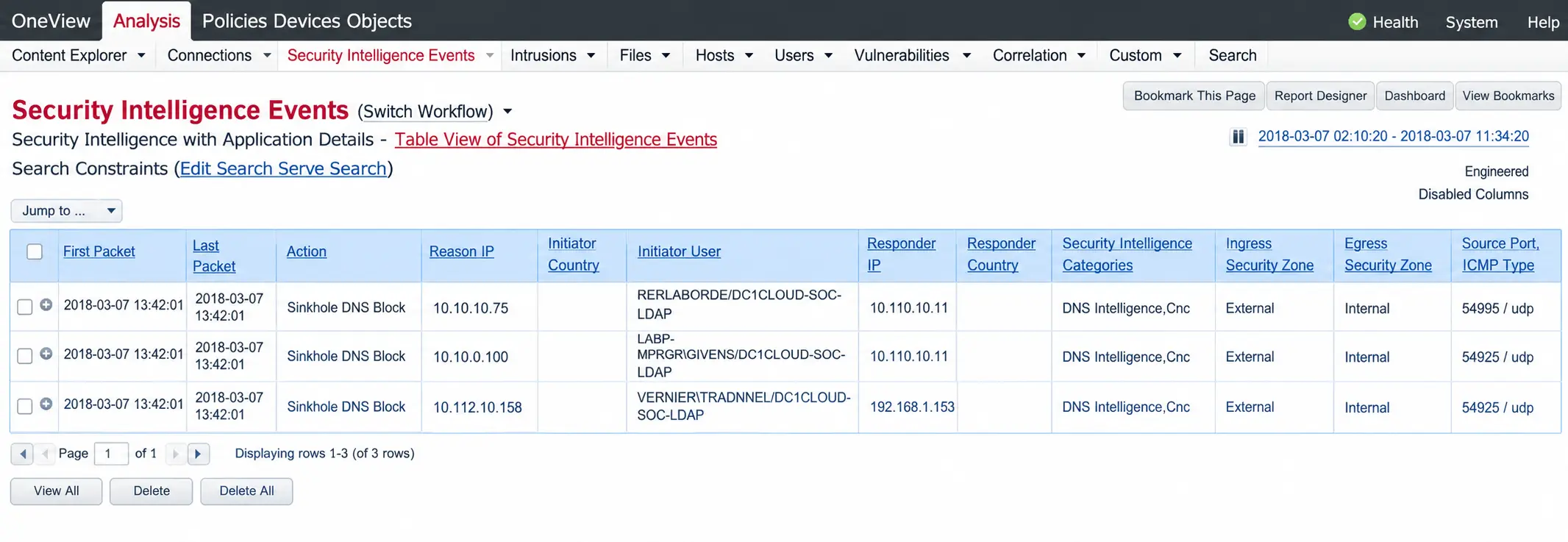
Which two elements in the table are parts of the 5-tuple? (Choose two.)
-
Option A:Correct
First Packet
-
Option B:Correct
Initiator User
-
Option C:Correct
Ingress Security Zone
-
Option D:Correct
Source Port
-
Option E:Correct
Show Answer & Explanation Hide Answer & Explanation
Correct Answer: D, E
Explanation
The 5-tuple refers to the five different values that are used to define a specific communication session in a network. These values include the source IP address, destination IP address, source port, destination port, and the protocol in use. In this case, option D (Source Port) and option E (Initiator IP) are parts of the 5-tuple. References := Cisco Cybersecurity Operations Fundamentals
-
-
Question 8
Single answerWhich type of data collection requires the largest amount of storage space?
-
Option A:Correct
alert data
-
Option B:Correct
transaction data
-
Option C:Correct
session data
-
Option D:Correct
Show Answer & Explanation Hide Answer & Explanation
Correct Answer: D
Explanation
Full packet capture requires the largest amount of storage space because it involves recording all packets that pass through a network, including all headers and payloads. This type of data collection is comprehensive and allows for detailed analysis, but due to the volume of data it encompasses, it demands significant storage capacity1.
References := The Cisco Secure Network Analytics Data Store Design Guide discusses the storage requirements for different types of network data collection, highlighting the substantial storage needs for full packet captures1.
-
-
Question 9
Single answerA company had a recent breach and lost confidential data to a competitor. An internal investigation found out that a new junior accounting specialist logged in to the accounting server with their user ID and stole confidential data. The junior accounting specialist denies the action and claims that the attempt was done by someone else. During court proceedings, the company presents logs and CCTV camera recordings that show the malicious insider in action. Which type of evidence has the company presented?
-
Option A:Correct
indirect and corroborative
-
Option B:Correct
direct and corroborative
-
Option C:Correct
circumstantial and direct
-
Option D:Correct
Show Answer & Explanation Hide Answer & Explanation
Correct Answer: B
-
-
Question 10
Single answerWhat is the functionality of an IDS ' ?
-
Option A:Correct
device or software that detects and blocks suspicious files
-
Option B:Correct
endpoint protection software that prevents viruses and malware
-
Option C:Correct
forensic tool used to perform an in-depth analysis and debugging
-
Option D:Correct
Show Answer & Explanation Hide Answer & Explanation
Correct Answer: D
-
-
Question 11
Single answerWhich security principle is violated by running all processes as root or administrator?
-
Option A:Correct
principle of least privilege
-
Option B:Correct
role-based access control
-
Option C:Correct
separation of duties
-
Option D:Correct
Show Answer & Explanation Hide Answer & Explanation
Correct Answer: A
Explanation
Running all processes as root or administrator violates the principle of least privilege, which states that users and processes should be granted only the minimum permissions necessary to perform their specific role or function within an organization. Running all processes as root or administrator gives them full access and control over the system, which increases the risk of unauthorized actions, malicious attacks, and accidental errors. It also makes it easier for attackers to escalate their privileges and compromise the system. References:
Understanding Cisco Cybersecurity Operations Fundamentals (CBROPS) v1.0, Module 1: Security Concepts, Lesson 1.2: Security Principles
Cisco Certified CyberOps Associate Overview, Exam Topics, 1.1 Explain the CIA triad
-