
| Exam Code | CNX-001 |
| Exam Name | CompTIA CloudNetX |
| Vendor | CompTIA |
| Total Questions | 84 |
| Last Updated | 26-Oct, 2026 |
- Latest & Verified Questions
- Detailed Explanations
- Regular Updates
- Full-Length Practice Tests
- Boost Your Exam Confidence
PDF Study Materials
Downloadable guides and resources
Practice Tests
Full-length tests with real exam experience
Progress Tracking
Monitor your performance and improvement
Study Anywhere
Access on desktop, tablet, and mobile
Free CNX-001 Practice Questions
Explore 9 free practice questions for the CompTIA CNX-001 exam and review the answers and explanations to support your preparation.
-
Question 1
Single answerA company is experiencing Wi-Fi performance issues. Three Wi-Fi networks are available, each
running on the 2.4 GHz band and on the same channel. Connecting to each Wi-Fi network yields slow
performance. Which of the following channels should the networks be configured to?-
Option A:Correct
Channel 1, Channel 2. and Channel 3
-
Option B:Correct
Channel 2. Channel 4, and Channel 9
-
Option C:Correct
Channel 1, Channel 6, and Channel 11
-
Option D:Correct
Channel 3, Channel 5, and Channel 10
Show Answer & Explanation Hide Answer & Explanation
Correct Answer: C
Explanation
These are the three non-overlapping channels in the 2.4 GHz band, eliminating co-channel and
adjacent-channel interference for optimal Wi-Fi performance.a -
-
Question 2
Single answerAs part of a project to modernize a sports stadium and improve the customer service experience for
fans, the stadium owners want to implement a new wireless system. Currently, all tickets are
electronic and managed by the stadium mobile application. The new solution is required to allow
location tracking precision within 5ft (1.5m) of fans to deliver the following services:
Emergency/security assistance
Mobile food order
Event special effects
Rafle winner location displayed on the giant stadium screen
Which of the following technologies enables location tracking?-
Option A:Correct
SSID
-
Option B:Correct
BLE
-
Option C:Correct
NFC
-
Option D:Correct
IoT
Show Answer & Explanation Hide Answer & Explanation
Correct Answer: B
Explanation
BLE (Bluetooth Low Energy) is a wireless personal area network (WPAN) technology designed for
applications that require lower energy consumption and reduced cost while maintaining a
communication range similar to classic Bluetooth. BLE supports location tracking with an accuracy
range typically between 1 to 2 meters (approximately 3 to 6 feet), making it ideal for applications
that demand fine-grained location services, such as stadium services requiring real-time user
proximity data.
According to the CompTIA CloudNetX CNX-001 Official Objectives, under the Network Architecture
domain, specifically in the subdomain:
"Wireless Technologies: Identify capabilities of BLE, NFC, RFID, and IoT devices within a network environment,
" it is outlined that: "BLE enables proximity-based services and real-time indoor location
tracking with high accuracy
when used with beacon infrastructure.
"
"BLE beacons can be deployed throughout a physical space, transmitting signals received by mobile
applications to determine a user’s location within a few feet.
"
"BLE is widely adopted for use cases including indoor navigation, asset tracking, and personalized
user engagement, making it a critical technology for modern high-density venues such as stadiums.
"
In comparison:
SSID merely identifies a wireless network and has no location tracking function.
NFC requires close contact (under 4 cm), and is not suitable for continuous or broad-range tracking.
IoT is an overarching category that includes connected devices and sensors; however, IoT is not a
standalone location tracking technology. It may include BLE as a component, but BLE specifically
provides the precise location tracking functionality.
These distinctions are explicitly addressed in the CompTIA CloudNetX CNX-001 Study Guide, under
the section:
“Emerging Network Technologies and Architectures”
, where BLE is described as a key enabling
technology for context-aware and location-based services in enterprise and public environments. -
-
Question 3
Drag & DropHOTSPOT
Questions & Answers PDF Page 14
You are designing a campus network with a three-tier hierarchy and need to ensure secure
connectivity between locations and traveling employees.
INSTRUCTIONS
Review the command output by clicking on the server, laptops, and workstations on the network.
Use the drop-down menus to determine the appropriate technology and label for each layer on the
diagram. Options may only be used once.
Click on the magnifying glass to make additional configuration changes.
If at any time you would like to bring back the initial state of the simulation, please click the Reset All
button.Show Answer & Explanation Hide Answer & Explanation
Correct Answer

Explanation
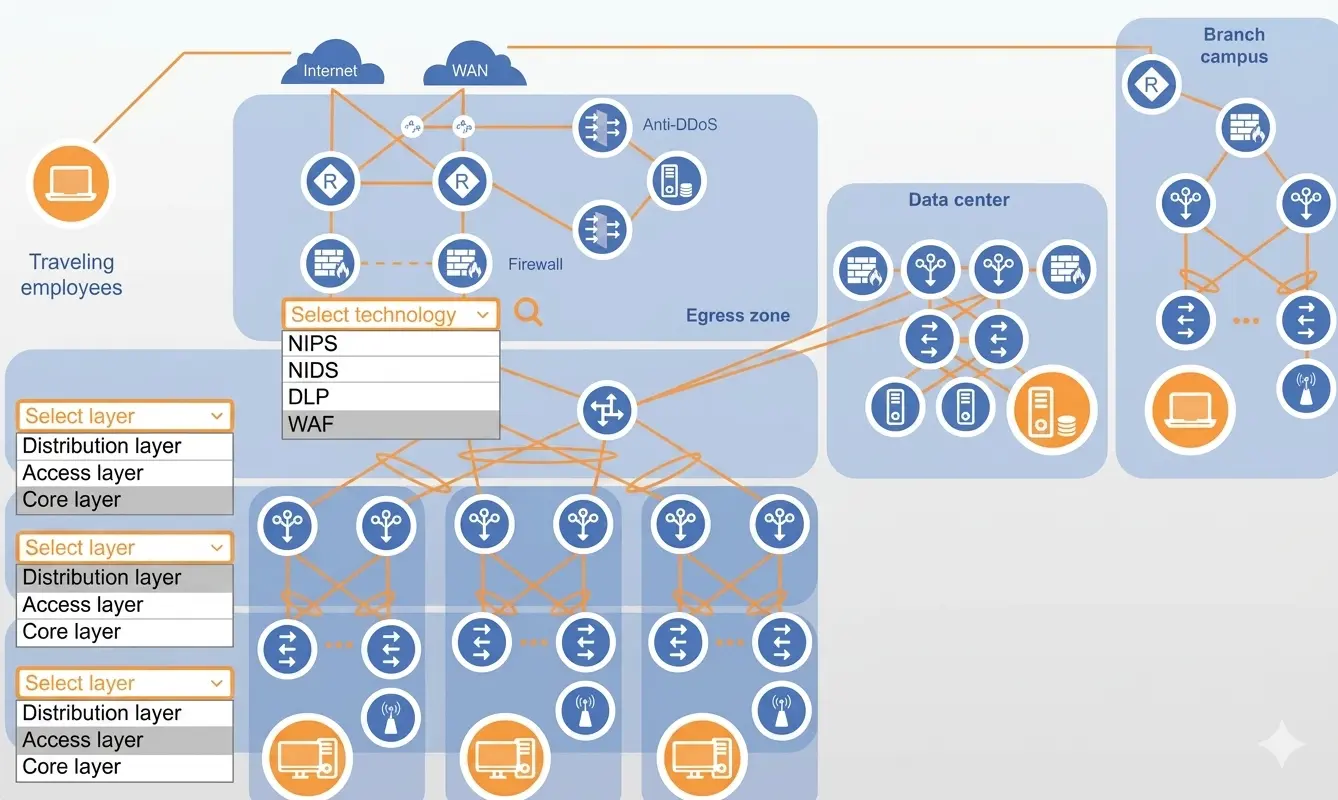
-
Question 4
Single answerA network architect must ensure only certain departments can access specific resources while on premises. Those same users cannot be allowed to access those resources once they have left campus. Which of the following would ensure access is provided according to these requirements?
-
Option A:Correct
Enabling MFA for only those users within the departments needing access
-
Option B:Correct
Configuring geofencing with the IPs of the resources
-
Option C:Correct
Configuring UEBA to monitor all access to those resources during non-business hours
-
Option D:Correct
Show Answer & Explanation Hide Answer & Explanation
Correct Answer: B
Explanation
Comprehensive and Detailed Explanation From Exact Extract:
Geofencing is a network access control method that enforces restrictions based on location data. In this scenario, the organization requires access to be permitted only when users are on premises (i.e., within a specific physical location). Geofencing can be implemented using source IP ranges or GPS-based location data to define boundaries (fences). This allows access to certain applications or services only when the user is inside a designated network or area.
MFA (Option A) provides identity assurance but does not enforce physical location-based restrictions.
UEBA (Option C) provides behavioral analytics but is not used for real-time access control.
PKI (Option D) provides identity validation through certificates but is not location-aware.
Relevant Extract from CompTIA CloudNetX CNX-001 Official Study Guide:
“Geofencing allows organizations to define physical or logical boundaries that restrict or allow access based on user location. Policies can be configured to allow access only when users are on a trusted campus or corporate network, denying requests originating from outside the geofenced area.”
Covered under the topic: “Access Control Technologies and Identity Enforcement Mechanisms.”
-
-
Question 5
Single answerA user reports an issue connecting to a database server. The front-end application for this database is hosted on the company's web server. The network engineer has changed the network subnet that the company servers are located on along with the IP addresses of the servers. These are the new configurations:
New subnet for the servers is 10.10.10.64/27
Web server IP address is 10.10.10.101
Database server IP is 10.10.10.93
Which of the following is most likely causing the user's issue?
-
Option A:Correct
The web application server is not forwarding the requests.
-
Option B:Correct
The database server firewall is blocking the port to the database.
-
Option C:Correct
The DNS server is not resolving properly.
-
Option D:Correct
Show Answer & Explanation Hide Answer & Explanation
Correct Answer: C
Explanation
Comprehensive and Detailed Explanation From Exact Extract:
Since the subnet and IPs were changed recently, and users are accessing the database through a web application, the likely issue is that DNS records have not been updated to reflect the new IP addresses. If DNS is pointing to old IPs, users will fail to reach the services even if they are up and reachable on the new subnet.
Relevant Extract from CompTIA CloudNetX CNX-001 Study Guide — under “DNS and Network Configuration Troubleshooting”:
“DNS misconfiguration is a common issue following IP address changes. If DNS entries are not updated accordingly, clients will attempt to reach services at outdated IPs.”
Other options:
A. No indication of web server misconfiguration is provided.
B. Firewall issues would affect all users, not just one.
D. The web server has a valid IP in the subnet range; no misconfiguration is indicated.
-
-
Question 6
Single answerAfter a company migrated all services to the cloud, the security auditor discovers many users have administrator roles on different services. The company needs a solution that:
Protects the services on the cloud
Limits access to administrative roles
Creates a policy to approve requests for administrative roles on critical services within a limited time
Forces password rotation for administrative roles
Audits usage of administrative roles
Which of the following is the best way to meet the company's requirements?
-
Option A:Correct
Privileged access management
-
Option B:Correct
Session-based token
-
Option C:Correct
Conditional access
-
Option D:Correct
Show Answer & Explanation Hide Answer & Explanation
Correct Answer: A
Explanation
Comprehensive and Detailed Explanation From Exact Extract:
Privileged Access Management (PAM) is the optimal solution to control, audit, and secure administrative access to systems and services. PAM enables role-based approval workflows, time-limited access, auditing, and credential rotation, fully aligning with the requirements.
Relevant Extract from CompTIA CloudNetX CNX-001 Study Guide — under “Identity and Access Controls”:
“Privileged Access Management allows fine-grained control over administrator-level access, supports just-in-time access provisioning, password rotation, and audit logging.”
Other options:
B. Session-based tokens allow temporary access but do not enforce policies or auditing.
C. Conditional access provides policy enforcement based on context but lacks full PAM features.
D. ACLs control access to resources but don’t manage privilege workflows or audits.
-
-
Question 7
Single answerA network engineer is setting up guest access on a Wi-Fi network. After a recent network analysis, the engineer discovered that a user could access the guest network and attack the corporate network, since the networks share the same VLAN. Which of the following should the engineer do to prevent an attack like this one from happening?
-
Option A:Correct
Configure Layer 2 client isolation for the wireless network.
-
Option B:Correct
Set up a MAC filtering rule and add the MAC addresses of all corporate devices to the allow list.
-
Option C:Correct
Set up a strong password on the guest wireless network.
-
Option D:Correct
Set up a captive portal so all guest users have to register before gaining access to the wireless network.
Show Answer & Explanation Hide Answer & Explanation
Correct Answer: A
Explanation
Comprehensive and Detailed Explanation From Exact Extract:
Layer 2 client isolation ensures that devices connected to the same wireless network (such as a guest SSID) cannot communicate with each other or other VLANs. This prevents guest users from scanning or attacking internal devices. It’s a fundamental security control for guest Wi-Fi access.
Relevant Extract from CompTIA CloudNetX CNX-001 Study Guide — under “Wireless Network Segmentation and Security”:
“Client isolation prevents peer-to-peer attacks over Wi-Fi by ensuring wireless clients cannot communicate with one another, a necessary control on shared guest networks.”
Other options:
B. MAC filtering is easy to spoof and hard to manage at scale.
C. Strong passwords improve access control but don’t isolate guest traffic.
D. Captive portals add a registration layer but don’t address VLAN or broadcast isolation.
-
-
Question 8
Single answerA large commercial enterprise that runs a global video streaming platform recently acquired a small business that serves customers in a geographic area with limited connectivity to the global telecommunications infrastructure. The executive leadership team issued a mandate to deliver the highest possible video streaming quality to all customers around the world. Which of the following solutions should the enterprise architect suggest to meet the requirements?
-
Option A:Correct
Serve the customers in the acquired area with a highly compressed version of content.
-
Option B:Correct
Use a geographically weighted DNS solution to distribute the traffic.
-
Option C:Correct
Deploy multiple local load balancers in the newly added geographic area.
-
Option D:Correct
Show Answer & Explanation Hide Answer & Explanation
Correct Answer: D
Explanation
Comprehensive and Detailed Explanation From Exact Extract:
A Content Delivery Network (CDN) distributes content across geographically distributed edge locations to provide faster access and higher quality to users, especially in areas with suboptimal connectivity to central data centers. By caching and serving content from edge servers near users, CDNs reduce latency and improve streaming performance globally.
Relevant Extract from CompTIA CloudNetX CNX-001 Study Guide — under “CDN and Cloud Edge Services”:
“CDNs provide globally distributed edge nodes for content caching and delivery, ensuring low-latency, high-bandwidth access for end users regardless of their location.”
Other options:
A. Reduces quality, contrary to the stated goal.
B. DNS-based routing helps with direction but does not solve content delivery or bandwidth issues.
C. Load balancers help distribute traffic locally, but do not provide edge caching or bandwidth optimization.
-
-
Question 9
Single answerA network architect needs to build a new data center for a large company that has business units that process retail financial transactions. Which of the following information should the architect request from the company?
-
Option A:Correct
Regulatory requirements
-
Option B:Correct
Statement of work
-
Option C:Correct
Business case study
-
Option D:Correct
Show Answer & Explanation Hide Answer & Explanation
Correct Answer: A
Explanation
Comprehensive and Detailed Explanation From Exact Extract:
When building infrastructure for business units that process financial transactions (such as in the retail or banking sector), the architect must first understand all relevant compliance and regulatory requirements. These may include PCI DSS, SOX, or GDPR, depending on the nature of the data and jurisdiction. These regulations influence design decisions regarding encryption, segmentation, data retention, and logging.
Relevant Extract from CompTIA CloudNetX CNX-001 Study Guide — under “Compliance and Regulatory Considerations”:
“Regulatory requirements such as PCI DSS, HIPAA, and others dictate the security controls, logging, data protection, and architectural design of infrastructure handling sensitive or financial data.”
Other options:
B. Statement of Work defines project scope, but doesn't include legal/compliance mandates.
C. Business case studies illustrate value or ROI, not security or compliance needs.
D. Internal reference architectures may help with standards but are based on already defined requirements.
-