
CompTIA CloudNetX CNX-001 Exam Questions
Preparing for the CNX-001 exam is simple with CertsPoint. We offer easy-to-understand study materials that help you learn the most important exam topics. You can study using our PDF questions, practice online with a real exam-style test, or use the desktop practice software. Choose the study method that works best for you and prepare at your own pace.
At CertsPoint, we keep our CNX-001 practice questions up to date. Whenever the exam syllabus or objectives change, we update our study materials so you always learn the latest topics. This helps you save time, avoid outdated content, and feel more confident when you take your exam.
A company is experiencing Wi-Fi performance issues. Three Wi-Fi networks are available, each
running on the 2.4 GHz band and on the same channel. Connecting to each Wi-Fi network yields slow
performance. Which of the following channels should the networks be configured to?
Correct Answer: C
These are the three non-overlapping channels in the 2.4 GHz band, eliminating co-channel and
adjacent-channel interference for optimal Wi-Fi performance.a
As part of a project to modernize a sports stadium and improve the customer service experience for
fans, the stadium owners want to implement a new wireless system. Currently, all tickets are
electronic and managed by the stadium mobile application. The new solution is required to allow
location tracking precision within 5ft (1.5m) of fans to deliver the following services:
Emergency/security assistance
Mobile food order
Event special effects
Rafle winner location displayed on the giant stadium screen
Which of the following technologies enables location tracking?
Correct Answer: B
BLE (Bluetooth Low Energy) is a wireless personal area network (WPAN) technology designed for
applications that require lower energy consumption and reduced cost while maintaining a
communication range similar to classic Bluetooth. BLE supports location tracking with an accuracy
range typically between 1 to 2 meters (approximately 3 to 6 feet), making it ideal for applications
that demand fine-grained location services, such as stadium services requiring real-time user
proximity data.
According to the CompTIA CloudNetX CNX-001 Official Objectives, under the Network Architecture
domain, specifically in the subdomain:
"Wireless Technologies: Identify capabilities of BLE, NFC, RFID, and IoT devices within a network environment,
" it is outlined that: "BLE enables proximity-based services and real-time indoor location
tracking with high accuracy
when used with beacon infrastructure.
"
"BLE beacons can be deployed throughout a physical space, transmitting signals received by mobile
applications to determine a user’s location within a few feet.
"
"BLE is widely adopted for use cases including indoor navigation, asset tracking, and personalized
user engagement, making it a critical technology for modern high-density venues such as stadiums.
"
In comparison:
SSID merely identifies a wireless network and has no location tracking function.
NFC requires close contact (under 4 cm), and is not suitable for continuous or broad-range tracking.
IoT is an overarching category that includes connected devices and sensors; however, IoT is not a
standalone location tracking technology. It may include BLE as a component, but BLE specifically
provides the precise location tracking functionality.
These distinctions are explicitly addressed in the CompTIA CloudNetX CNX-001 Study Guide, under
the section:
“Emerging Network Technologies and Architectures”
, where BLE is described as a key enabling
technology for context-aware and location-based services in enterprise and public environments.
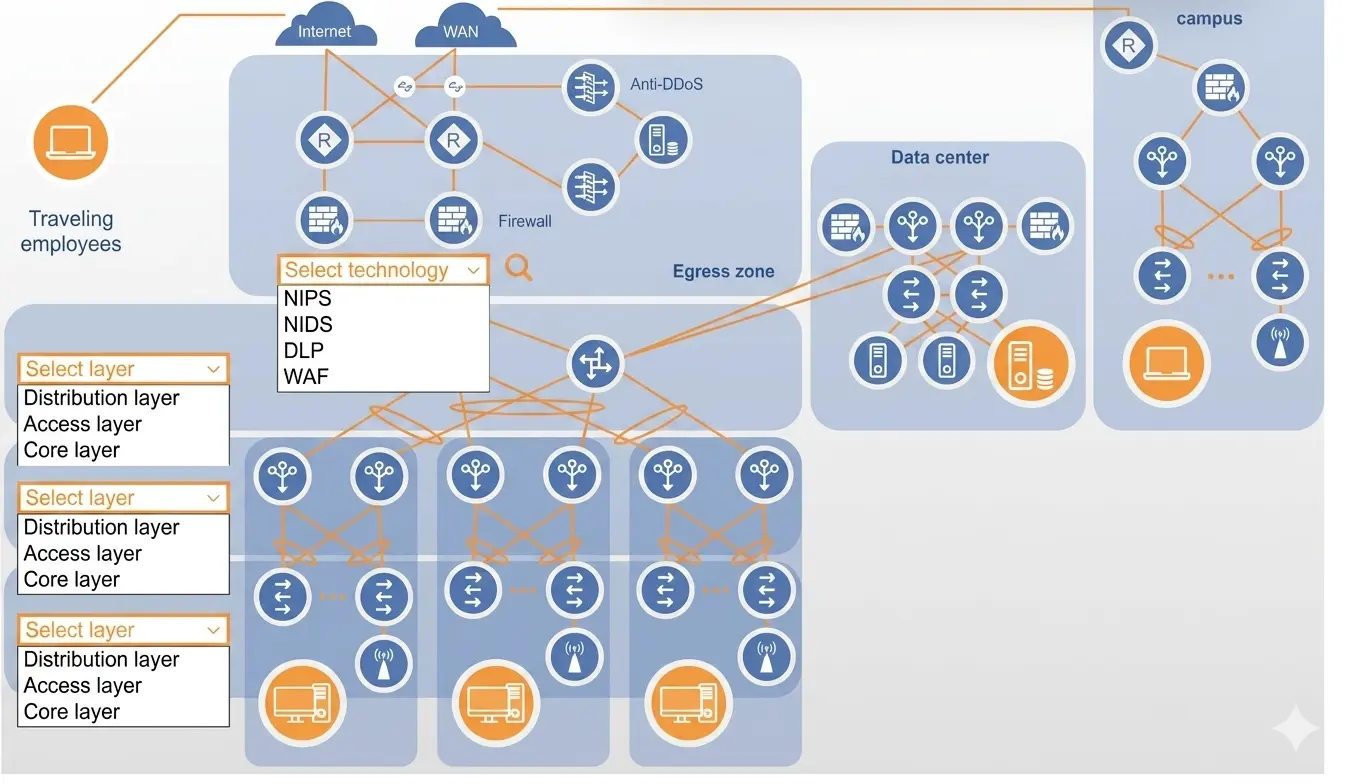
HOTSPOT
Questions & Answers PDF Page 14
You are designing a campus network with a three-tier hierarchy and need to ensure secure
connectivity between locations and traveling employees.
INSTRUCTIONS
Review the command output by clicking on the server, laptops, and workstations on the network.
Use the drop-down menus to determine the appropriate technology and label for each layer on the
diagram. Options may only be used once.
Click on the magnifying glass to make additional configuration changes.
If at any time you would like to bring back the initial state of the simulation, please click the Reset All
button.
Answer
A network architect must ensure only certain departments can access specific resources while on premises. Those same users cannot be allowed to access those resources once they have left campus. Which of the following would ensure access is provided according to these requirements?
Correct Answer: B
Comprehensive and Detailed Explanation From Exact Extract:
Geofencing is a network access control method that enforces restrictions based on location data. In this scenario, the organization requires access to be permitted only when users are on premises (i.e., within a specific physical location). Geofencing can be implemented using source IP ranges or GPS-based location data to define boundaries (fences). This allows access to certain applications or services only when the user is inside a designated network or area.
MFA (Option A) provides identity assurance but does not enforce physical location-based restrictions.
UEBA (Option C) provides behavioral analytics but is not used for real-time access control.
PKI (Option D) provides identity validation through certificates but is not location-aware.
Relevant Extract from CompTIA CloudNetX CNX-001 Official Study Guide:
“Geofencing allows organizations to define physical or logical boundaries that restrict or allow access based on user location. Policies can be configured to allow access only when users are on a trusted campus or corporate network, denying requests originating from outside the geofenced area.”
Covered under the topic: “Access Control Technologies and Identity Enforcement Mechanisms.”
A user reports an issue connecting to a database server. The front-end application for this database is hosted on the company's web server. The network engineer has changed the network subnet that the company servers are located on along with the IP addresses of the servers. These are the new configurations:
New subnet for the servers is 10.10.10.64/27
Web server IP address is 10.10.10.101
Database server IP is 10.10.10.93
Which of the following is most likely causing the user's issue?
Correct Answer: C
Comprehensive and Detailed Explanation From Exact Extract:
Since the subnet and IPs were changed recently, and users are accessing the database through a web application, the likely issue is that DNS records have not been updated to reflect the new IP addresses. If DNS is pointing to old IPs, users will fail to reach the services even if they are up and reachable on the new subnet.
Relevant Extract from CompTIA CloudNetX CNX-001 Study Guide — under “DNS and Network Configuration Troubleshooting”:
“DNS misconfiguration is a common issue following IP address changes. If DNS entries are not updated accordingly, clients will attempt to reach services at outdated IPs.”
Other options:
A. No indication of web server misconfiguration is provided.
B. Firewall issues would affect all users, not just one.
D. The web server has a valid IP in the subnet range; no misconfiguration is indicated.