
| Exam Code | Databricks-Machine-Learning-Professional |
| Exam Name | Databricks Databricks-Machine-Learning-Professional Exam |
| Vendor | Databricks |
| Total Questions | 60 |
| Last Updated | 26-Oct, 2026 |
- Latest & Verified Questions
- Detailed Explanations
- Regular Updates
- Full-Length Practice Tests
- Boost Your Exam Confidence
PDF Study Materials
Downloadable guides and resources
Practice Tests
Full-length tests with real exam experience
Progress Tracking
Monitor your performance and improvement
Study Anywhere
Access on desktop, tablet, and mobile
Free Databricks-Machine-Learning-Professional Practice Questions
Explore 10 free practice questions for the Databricks Databricks-Machine-Learning-Professional exam and review the answers and explanations to support your preparation.
-
Question 1
Single answerA machine learning engineer is attempting to create a webhook that will trigger a Databricks Job job_id when a model version for model model transitions into any MLflow Model Registry stage.
They have the following incomplete code block:
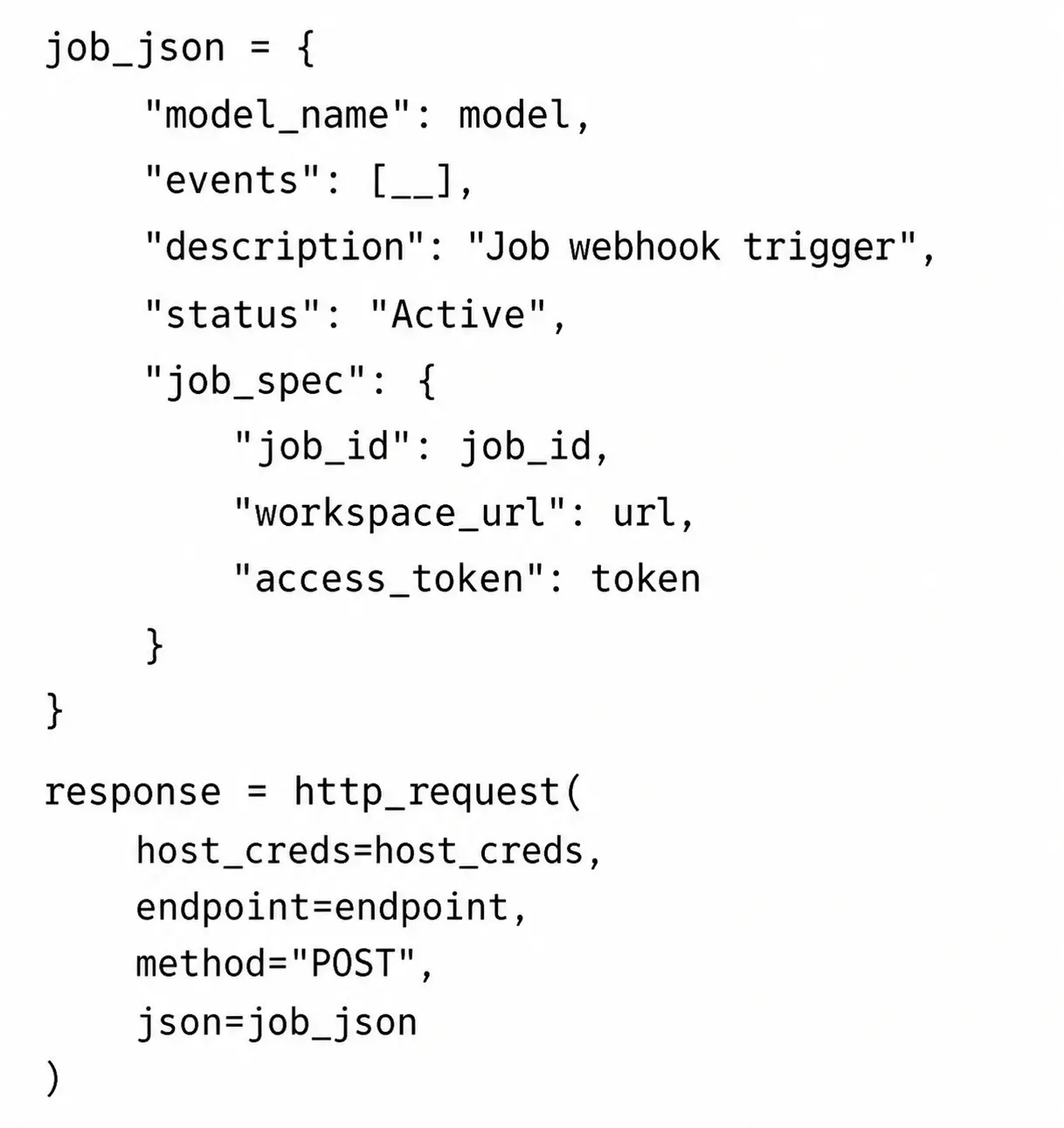
Which of the following lines of code can be used to fill in the blank so that the code block accomplishes the task?
-
Option A:Correct
"MODEL_VERSION_CREATED"
-
Option B:Correct
"MODEL_VERSION_TRANSITIONED_TO_PRODUCTION"
-
Option C:Correct
"MODEL_VERSION_TRANSITIONED_TO_STAGING"
-
Option D:Correct
"MODEL_VERSION_TRANSITIONED_STAGE"
-
Option E:Correct
"MODEL_VERSION_TRANSITIONED_TO_STAGING",
"MODEL_VERSION_TRANSITIONED_TO_PRODUCTION"
Show Answer & Explanation Hide Answer & Explanation
Correct Answer: D
Explanation
The correct line of code is “MODEL_VERSION_TRANSITIONED_STAGE”, which is the name of the event that occurs when a model version transitions to any stage in the MLflow Model Registry. This event can be used to trigger a webhook that will execute a Databricks Job based on the model version and the stage it transitions to. The other options are either invalid event names or too specific for the task.
References: MLflow Model Registry Webhooks , MLflow Model Registry Events
-
-
Question 2
Single answerA machine learning engineer is converting a Hyperopt-based hyperparameter tuning process from manual MLflow logging to MLflow Autologging. They are trying to determine how to manage nested Hyperopt runs with MLflow Autologging.
Which of the following approaches will create a single parent run for the process and a child run for each unique combination of hyperparameter values when using Hyperopt and MLflow Autologging?
-
Option A:Correct
Startinq a manual parent run before calling fmin
-
Option B:Correct
Ensuring that a built-in model flavor is used for the model logging
-
Option C:Correct
Starting a manual child run within the objective function
-
Option D:Correct
There is no way to accomplish nested runs with MLflow Autoloqqinq and Hyperopt
-
Option E:Correct
Show Answer & Explanation Hide Answer & Explanation
Correct Answer: E
Explanation
MLflow Autologging is a feature that automatically logs parameters, metrics, and artifacts for machine learning frameworks, such as Hyperopt, without requiring any code changes. When using MLflow Autologging with Hyperopt, MLflow will automatically create a parent run for the hyperparameter tuning process and a child run for each unique combination of hyperparameter values. This way, the user can easily compare and visualize the results of different hyperparameter settings in the MLflow UI. MLflow Autologging also supports nested runs, which means that if the user starts a manual run before calling fmin, the parent run will be nested under the manual run. This allows the user to organize and group related runs together. References: MLflow Autologging , Hyperparameter Tuning with MLflow, Apache Spark MLlib and Hyperopt , Using MLFlow with Hyperopt for Automated Machine Learning , Parallelize hyperparameter tuning with scikit-learn and MLflow , [Optimizing Model Performance with MLflow and Hyperopt: From Hyperparameter Tuning to Serving]
-
-
Question 3
Single answerA machine learning engineer is in the process of implementing a concept drift monitoring solution. They are planning to use the following steps:
1. Deploy a model to production and compute predicted values
2. Obtain the observed (actual) label values
3. _____
4. Run a statistical test to determine if there are changes over time
Which of the following should be completed as Step #3?
-
Option A:Correct
Obtain the observed values (actual) feature values
-
Option B:Correct
Measure the latency of the prediction time
-
Option C:Correct
Retrain the model
-
Option D:Correct
None of these should be completed as Step #3
-
Option E:Correct
Show Answer & Explanation Hide Answer & Explanation
Correct Answer: E
Explanation
Concept drift is a change in the relationship between input and output data over time, which can affect the performance and accuracy of the model. To monitor concept drift, one needs to compare the predicted values from the model with the observed (actual) label values from the data source. A common way to do this is to compute an evaluation metric, such as accuracy, precision, recall, F1-score, etc., using the observed and predicted values. This metric can indicate how well the model is performing on the current data, and how it differs from the baseline performance on the training data. If the metric shows a significant decline over time, it may suggest that concept drift has occurred and the model needs to be updated 1 2 3
References :
Monitoring Concept Drift - Databricks
Data drift, concept drift, and how to monitor for them - Mona Labs
8 Concept Drift Detection Methods To Use With ML Models - Aporia
-
-
Question 4
Single answerA machine learning engineer is converting a Hyperopt-based hyperparameter tuning process from manual MLflow logging to MLflow Autologging. They are trying to determine how to manage nested Hyperopt runs with MLflow Autologging.
Which of the following approaches will create a single parent run for the process and a child run for each unique combination of hyperparameter values when using Hyperopt and MLflow Autologging?
-
Option A:Correct
Startinq a manual parent run before calling fmin
-
Option B:Correct
Ensuring that a built-in model flavor is used for the model logging
-
Option C:Correct
Starting a manual child run within the objective function
-
Option D:Correct
There is no way to accomplish nested runs with MLflow Autoloqqinq and Hyperopt
-
Option E:Correct
Show Answer & Explanation Hide Answer & Explanation
Correct Answer: E
Explanation
MLflow Autologging is a feature that automatically logs parameters, metrics, and artifacts for machine learning frameworks, such as Hyperopt, without requiring any code changes. When using MLflow Autologging with Hyperopt, MLflow will automatically create a parent run for the hyperparameter tuning process and a child run for each unique combination of hyperparameter values. This way, the user can easily compare and visualize the results of different hyperparameter settings in the MLflow UI. MLflow Autologging also supports nested runs, which means that if the user starts a manual run before calling fmin, the parent run will be nested under the manual run. This allows the user to organize and group related runs together. References: MLflow Autologging , Hyperparameter Tuning with MLflow, Apache Spark MLlib and Hyperopt , Using MLFlow with Hyperopt for Automated Machine Learning , Parallelize hyperparameter tuning with scikit-learn and MLflow , [Optimizing Model Performance with MLflow and Hyperopt: From Hyperparameter Tuning to Serving]
-
-
Question 5
Single answerA machine learning engineer is converting a Hyperopt-based hyperparameter tuning process from manual MLflow logging to MLflow Autologging. They are trying to determine how to manage nested Hyperopt runs with MLflow Autologging.
Which of the following approaches will create a single parent run for the process and a child run for each unique combination of hyperparameter values when using Hyperopt and MLflow Autologging?
-
Option A:Correct
Startinq a manual parent run before calling fmin
-
Option B:Correct
Ensuring that a built-in model flavor is used for the model logging
-
Option C:Correct
Starting a manual child run within the objective function
-
Option D:Correct
There is no way to accomplish nested runs with MLflow Autoloqqinq and Hyperopt
-
Option E:Correct
Show Answer & Explanation Hide Answer & Explanation
Correct Answer: E
Explanation
MLflow Autologging is a feature that automatically logs parameters, metrics, and artifacts for machine learning frameworks, such as Hyperopt, without requiring any code changes. When using MLflow Autologging with Hyperopt, MLflow will automatically create a parent run for the hyperparameter tuning process and a child run for each unique combination of hyperparameter values. This way, the user can easily compare and visualize the results of different hyperparameter settings in the MLflow UI. MLflow Autologging also supports nested runs, which means that if the user starts a manual run before calling fmin, the parent run will be nested under the manual run. This allows the user to organize and group related runs together. References: MLflow Autologging , Hyperparameter Tuning with MLflow, Apache Spark MLlib and Hyperopt , Using MLFlow with Hyperopt for Automated Machine Learning , Parallelize hyperparameter tuning with scikit-learn and MLflow , [Optimizing Model Performance with MLflow and Hyperopt: From Hyperparameter Tuning to Serving]
-
-
Question 6
Single answerWhich of the following is a simple, low-cost method of monitoring numeric feature drift?
-
Option A:Correct
Jensen-Shannon test
-
Option B:Correct
Summary statistics trends
-
Option C:Correct
Chi-squared test
-
Option D:Correct
None of these can be used to monitor feature drift
-
Option E:Correct
Show Answer & Explanation Hide Answer & Explanation
Correct Answer: B
Explanation
Feature drift is a change in the distribution of the input data over time, which can affect the performance and accuracy of the model. Monitoring feature drift is important to ensure that the model is still valid and reliable for the current data. One simple and low-cost method of monitoring numeric feature drift is to track the summary statistics trends of the input features, such as mean, standard deviation, minimum, maximum, etc. These statistics can be computed easily and efficiently, and can provide a quick overview of the changes in the data distribution. If the summary statistics deviate significantly from the baseline values, it may indicate a feature drift. However, summary statistics trends may not capture all the nuances of the data distribution, such as outliers, multimodality, skewness, etc. Therefore, other methods, such as statistical tests or visualizations, may be needed to complement the summary statistics trends and provide a more comprehensive analysis of the feature drift 1 2 3 References :
Monitoring Feature Drift - Databricks
Monitor feature attribution skew and drift | Vertex AI | Google Cloud
Monitoring Model Drift - 6 Different Methodologies - Qualdo
-
-
Question 7
Single answerA machine learning engineer is migrating a machine learning pipeline to use Databricks Machine Learning. They have programmatically identified the best run from an MLflow Experiment and stored its URI in the model_uri variable and its Run ID in the run_id variable. They have also determined that the model was logged with the name "model" . Now, the machine learning engineer wants to register that model in the MLflow Model Registry with the name "best_model" .
Which of the following lines of code can they use to register the model to the MLflow Model Registry?
-
Option A:Correct
mlflow.register_model(model_uri, "best_model")
-
Option B:Correct
mlflow.register_model(run_id, "best_model")
-
Option C:Correct
mlflow.register_model(f"runs:/{run_id}/best_model", "model")
-
Option D:Correct
mlflow.register_model(model_uri, "model")
-
Option E:Correct
Show Answer & Explanation Hide Answer & Explanation
Correct Answer: A
Explanation
The mlflow.register_model function takes two arguments: model_uri and name. The model_uri is the URI of the model that was logged to MLflow, which can be obtained from the best run object. The name is the name of the registered model in the MLflow Model Registry. Therefore, the correct line of code to register the model is:
mlflow.register_model(model_uri, “best_model”)
This will create a new registered model with the name “best_model” and register the model version from the best run as the first version of that model.
References:
[mlflow.register_model — MLflow 1.22.0 documentation]
[MLflow Model Registry — Databricks Documentation]
[Manage MLflow Models — Databricks Documentation] Message has links.
-
-
Question 8
Single answerWhich of the following deployment paradigms can centrally compute predictions for a single record with exceedingly fast results?
-
Option A:Correct
Streaming
-
Option B:Correct
Batch
-
Option C:Correct
Edge/on-device
-
Option D:Correct
None of these strategies will accomplish the task.
-
Option E:Correct
Show Answer & Explanation Hide Answer & Explanation
Correct Answer: E
Explanation
Real-time deployment is a paradigm that can centrally compute predictions for a single record with exceedingly fast results. Real-time deployment involves exposing a model as a REST API endpoint that can receive requests and return predictions in milliseconds. This paradigm is suitable for scenarios where low latency and high throughput are required, such as fraud detection, recommendation systems, or chatbots. The other deployment paradigms are not as fast or as centralized as real-time deployment. Streaming deployment involves processing data streams in micro-batches, which can introduce some delay. Batch deployment involves processing large batches of data at scheduled intervals, which can take hours or days. Edge or on-device deployment involves deploying models to edge devices, such as mobile phones or IoT sensors, which can reduce the network overhead but also limit the computational power and model size. https://docs.databricks.com/en/machine-learning/ml-tutorials.html
-
-
Question 9
Single answerA machine learning engineer needs to select a deployment strategy for a new machine learning application. The feature values are not available until the time of delivery, and results are needed exceedingly fast for one record at a time.
Which of the following deployment strategies can be used to meet these requirements?
-
Option A:Correct
Edge/on-device
-
Option B:Correct
Streaming
-
Option C:Correct
None of these strategies will meet the requirements.
-
Option D:Correct
Batch
-
Option E:Correct
Show Answer & Explanation Hide Answer & Explanation
Correct Answer: E
Explanation
Real-time deployment is a type of model deployment where predictions are computed on-demand at query time. This can be useful when the feature values are not available until the time of delivery, and results are needed exceedingly fast for one record at a time. Real-time deployment can leverage Databricks Model Serving, which allows users to host MLflow models as REST endpoints on Databricks 1 . The other options are incorrect because they either do not meet the requirements or are not supported by Databricks Machine Learning. Edge/on-device deployment is a type of model deployment where predictions are computed on the edge device, such as a smartphone or a sensor. This can be useful when there is limited or no network connectivity, or when privacy and security are important. However, edge deployment is not supported by Databricks Machine Learning 2 . Streaming deployment is a type of model deployment where predictions are computed on streaming data, such as sensor readings or web logs. This can be useful when the data volume is high and the results need to be updated continuously. However, streaming deployment is not supported by Databricks Model Serving 1 . Batch deployment is a type of model deployment where predictions are computed in advance and stored for later use. This can be useful when the feature values are known ahead of time and the predictions do not need to be delivered quickly. However, batch deployment does not meet the requirements of this scenario, as the feature values are not available until the time of delivery, and results are needed exceedingly fast for one record at a time. References: MLflow Model Serving , Model deployment patterns
-
-
Question 10
Single answerWhich of the following describes label drift?
-
Option A:Correct
Label drift is when there is a change in the distribution of the predicted target given by the model
-
Option B:Correct
None of these describe label drift
-
Option C:Correct
Label drift is when there is a change in the distribution of an input variable
-
Option D:Correct
Label drift is when there is a change in the relationship between input variables and target variables
-
Option E:Correct
Show Answer & Explanation Hide Answer & Explanation
Correct Answer: E
Explanation
Label drift is a type of data drift that occurs when there is a change in the probability of a label P(Y). This means that the output distribution of the model’s data source has changed over time, which can affect the performance and accuracy of the model. For example, if a model is trained to classify images of animals, and the data source starts to provide more images of cats than dogs, this would be an example of label drift. Label drift can be caused by various factors, such as changes in user behavior, environmental conditions, market trends, etc. Label drift can be detected and handled by various methods, such as periodic retraining, online learning, ensemble methods, etc 1 2 3 References :
Monitoring Feature Drift - Databricks
Drift Metrics: How to Select the Right Metric to Analyze Drift
Detect data drift on datasets (preview) - Azure Machine Learning
-