
Exam Overview
| Exam Code | 77-725 |
| Exam Name | Microsoft Word 2016: Core Document Creation, Collaboration and Communication |
| Vendor | Microsoft |
| Total Questions | 35 |
| Last Updated | 26-Oct, 2026 |
Why CertsPoint?
- Latest & Verified Questions
- Detailed Explanations
- Regular Updates
- Full-Length Practice Tests
- Boost Your Exam Confidence
PDF Study Materials
Downloadable guides and resources
Practice Tests
Full-length tests with real exam experience
Progress Tracking
Monitor your performance and improvement
Study Anywhere
Access on desktop, tablet, and mobile
Secure Payment
Privacy Protected
Money Back Guarantee
Free 77-725 Practice Questions
Explore 2 free practice questions for the Microsoft 77-725 exam and review the answers and explanations to support your preparation.
-
Question 1
Drag & DropSIMULATION Project 1 of 7: Observation Overview You are a member of the Barstow College Observation Project committee. You are preparing the initial summary report for this year’s count, but have not received all of the data you need to complete the report.

Show Answer & Explanation Hide Answer & Explanation
Correct Answer
1. Select the cells in the bottom row of the table below the “Wilderness Summary” which you want to merge. 2. Under Table Tools, on the Layout tab, in the Merge group, select Merge Cells. OR 1. Select the cells in the bottom row of the table below the “Wilderness Summary” which you want to merge. 2. Right click and select Merge Cells. References: https://support.office.com/en-us/article/Merge-or-split-cells-in-a-table-8B458DEB-0FC5-4C8D-8D94- 2D4DA98193F8
Explanation
Introduction The multi-departmental Wildlife Observation Project has completed its wildlife population counts for this year. The counts were made between May 5 and May 7 for both the wilderness and cultivated land areas. This is in line with the count periods for all previous years. The species used for the counts have been identified as common for the region (central Missouri) in which the counts were taken. (Author, 2009) As in previous years, five observation blinds were set up two weeks before the counts were to take place. Counters worked eight-hour shifts providing 24-hour coverage of the count areas for two days. Weather for both observation days was clear and mild (varying between 50-70 degrees F). The results presented here are summary total results only, which counts from five and ten years ago provided for comparison. Detailed observation results will be available as soon as they are completed. We estimate that they will be available some time in the next two weeks. Wilderness Summary The wilderness observation area is a five-acre section of unimproved forest land. The most common trees in the area are maple, red oak, cedar, sweet gum, and hickory. The area also includes a small spring. The area is not enclosed by a fence or other man-made barrier. The area is located eight miles from the nearest paved road and twelve miles from the nearest residence. Off-road vehicles were used to bring counters close to, but not entering, the count area. The nearest approach by off-road vehicles was one mile. The table below lists the summary counts.
SpeciesCurrent CountFive years agoTen years agoWhite-tailed deer
14 12 10 Cottontail rabbit 26 28 25 Swamp rabbit 0 0 2 Mourning dove 18 59 102 Bobwhite quail 5 22 27 Eastern gray squirrel 23 20 31 Fox squirrel 6 11 9 NOTE TO REVIEW COMMITTEE: Don't you think i t's time we finally drop the swamp rabbit from the count as an anomaly? Cultivated Land Summary The cultivated land observation area is a five-acre section of cultivated land near the center of a 50- acre field. The field is used to grow corn, wheat, soybeans, and clover, with the crop rotated annually. In the fifth year of the cycle, the field is left fallow. The area is located two miles from the nearest paved road and one mile from the nearest residence. A storage barn is located at the southern border of the field. The table below lists the summary counts. Additional Notes This project was initially scheduled to run for ten years, so we are currently in our last year. The committee needs to decide if it is worth the time and expense to continue the project. The landowners have experience that they would be happy to let us continue. Costs relating to the project is minimal and it does provide an opportunity to offer extra credit to students volunteering as counters. A suggestion has been made by some committee members that we should increase the count frequency, counting on a quarterly schedule instead of an annual schedule. This would need to be coordinated with the owner of the cultivated field so that we do not interfere with planting or harvesting schedules. Special Thanks Once again, we would like to offer special thanks to: We couldn’t do this without you. Merge all cells in the bottom row of the table below the “Wilderness Summary” heading into one cell.
-
Question 2
Drag & DropSIMULATION Project 1 of 7: Observation Overview You are a member of the Barstow College Observation Project committee. You are preparing the initial summary report for this year’s count, but have not received all of the data you need to complete the report.
Show Answer & Explanation Hide Answer & Explanation
Correct Answer
1. Click below the text “The table below lists the summary counts.” where the table should be inserted. 2. Select Table from the Insert tab. 3. Drag through the grid to set eight rows and four columns (4x8 Table) as desired OR 1. Click below the text “The table below lists the summary counts.” where the table should be inserted. 2. Select Table from the Insert tab. 3. Select Insert Table from the options provided below and type four columns and eight rows in the appropriate boxes, then select OK. References: https://support.office.com/en-us/article/Insert-a-table-A138F745-73EF-4879-B99A-2F3D38BE612A
Explanation
Introduction The multi-departmental Wildlife Observation Project has completed its wildlife population counts for this year. The counts were made between May 5 and May 7 for both the wilderness and cultivated land areas. This is in line with the count periods for all previous years. The species used for the counts have been identified as common for the region (central Missouri) in which the counts were taken. (Author, 2009) As in previous years, five observation blinds were set up two weeks before the counts were to take place. Counters worked eight-hour shifts providing 24-hour coverage of the count areas for two days. Weather for both observation days was clear and mild (varying between 50-70 degrees F). The results presented here are summary total results only, which counts from five and ten years ago provided for comparison. Detailed observation results will be available as soon as they are completed. We estimate that they will be available some time in the next two weeks. Wilderness Summary The wilderness observation area is a five-acre section of unimproved forest land. The most common trees in the area are maple, red oak, cedar, sweet gum, and hickory. The area also includes a small spring. The area is not enclosed by a fence or other man-made barrier. The area is located eight miles from the nearest paved road and twelve miles from the nearest residence. Off-road vehicles were used to bring counters close to, but not entering, the count area. The nearest approach by off-road vehicles was one mile. The table below lists the summary counts
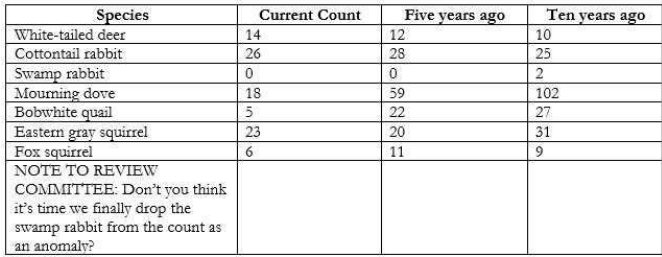
Cultivated Land Summary The cultivated land observation area is a five-acre section of cultivated land near the center of a 50- acre field. The field is used to grow corn, wheat, soybeans, and clover, with the crop rotated annually. In the fifth year of the cycle, the field is left fallow. The area is located two miles from the nearest paved road and one mile from the nearest residence. A storage barn is located at the southern border of the field. The table below lists the summary counts. Additional Notes This project was initially scheduled to run for ten years, so we are currently in our last year. The committee needs to decide if it is worth the time and expense to continue the project. The landowners have experience that they would be happy to let us continue. Costs relating to the project is minimal and it does provide an opportunity to offer extra credit to students volunteering as counters. A suggestion has been made by some committee members that we should increase the count frequency, counting on a quarterly schedule instead of an annual schedule. This would need to be coordinated with the owner of the cultivated field so that we do not interfere with planting or harvesting schedules. Special Thanks Once again, we would like to offer special thanks to: We couldn’t do this without you. Add a table with eight rows and four columns in the “Cultivated Land Summary” section, below the text “The table below lists the summary counts.”