
Exam Overview
| Exam Code | AZ-500 |
| Exam Name | Microsoft Azure Security Technologies |
| Vendor | Microsoft |
| Total Questions | 492 |
| Last Updated | 26-Oct, 2026 |
Why CertsPoint?
- Latest & Verified Questions
- Detailed Explanations
- Regular Updates
- Full-Length Practice Tests
- Boost Your Exam Confidence
PDF Study Materials
Downloadable guides and resources
Practice Tests
Full-length tests with real exam experience
Progress Tracking
Monitor your performance and improvement
Study Anywhere
Access on desktop, tablet, and mobile
Secure Payment
Privacy Protected
Money Back Guarantee
Free AZ-500 Practice Questions
Explore 7 free practice questions for the Microsoft AZ-500 exam and review the answers and explanations to support your preparation.
-
Question 1
Single answerYou need to configure WebApp1 to meet the data and application requirements.
Which two actions should you perform? Each correct answer presents part of the solution.
NOTE: Each correct selection is worth one point.-
Option A:Correct
Upload a public certificate.
-
Option B:Correct
Turn on the HTTPS Only protocol setting.
-
Option C:Correct
Set the Minimum TLS Version protocol setting to 1.2.
-
Option D:Correct
Change the pricing tier of the App Service plan.
-
Option E:Correct
Turn on the Incoming client certificates protocol setting.
Show Answer & Explanation Hide Answer & Explanation
Correct Answer: B
Explanation
-
-
Question 2
Single answerYou need to ensure that you can meet the security operations requirements.
What should you do first?-
Option A:Correct
Turn on Auto Provisioning in Security Center.
-
Option B:Correct
Integrate Security Center and Microsoft Cloud App Security.
-
Option C:Correct
Upgrade the pricing tier of Security Center to Standard.
-
Option D:Correct
Modify the Security Center workspace configuration.
Show Answer & Explanation Hide Answer & Explanation
Correct Answer: C
Explanation
The Standard tier extends the capabilities of the Free tier to workloads running in private and other
public clouds, providing unified security management and threat protection across your hybrid cloud
workloads. The Standard tier also adds advanced threat detection capabilities, which uses built-in
behavioral analytics and machine learning to identify attacks and zero-day exploits, access and
application controls to reduce exposure to network attacks and malware, and more.
Scenario: Security Operations Requirements
Litware must be able to customize the operating system security configurations in Azure Security
Center. -
-
Question 3
Single answerYou need to ensure that users can access VM0. The solution must meet the platform
protection requirements. What should you do?-
Option A:Correct
Move VM0 to Subnet1.
-
Option B:Correct
On
Firewall, configure a network traffic filtering rule. -
Option C:Correct
Assign RT1 to
AzureFirewallSubnet. -
Option D:Correct
On Firewall, configure a DNAT rule.
Show Answer & Explanation Hide Answer & Explanation
Correct Answer: D
Explanation
-
-
Question 4
Drag & DropHOTSPOT
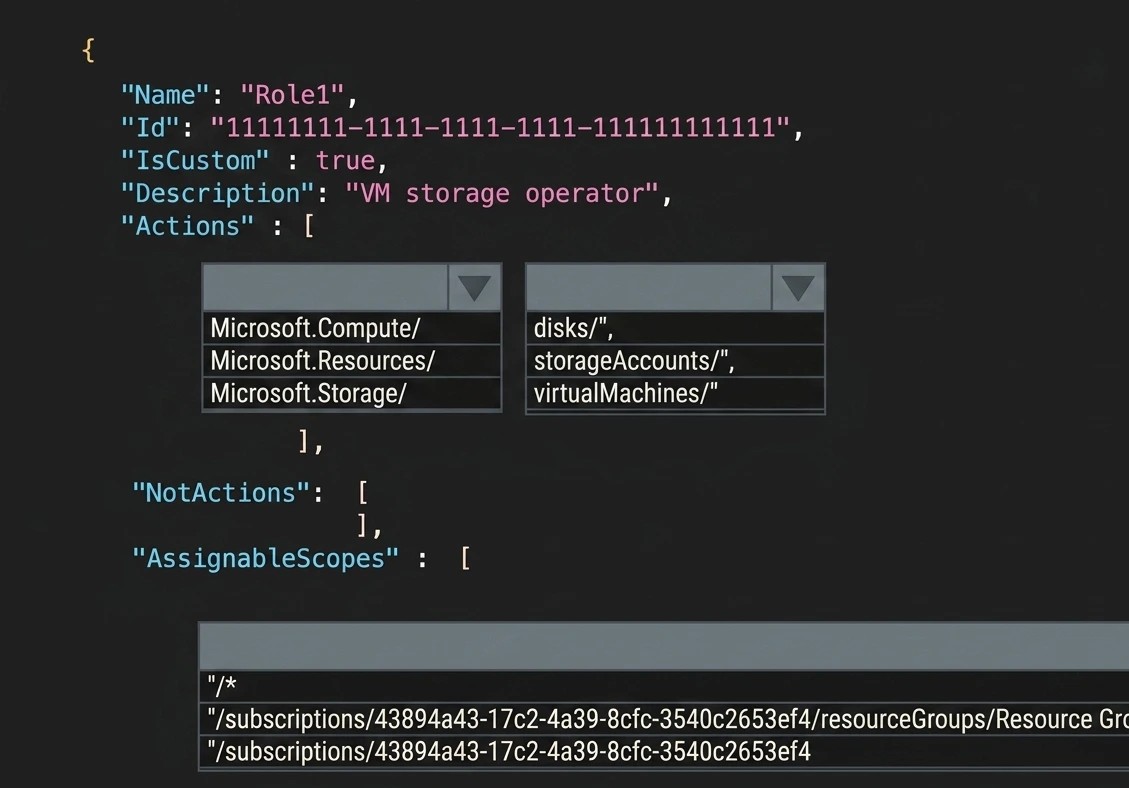
You need to create Role1 to meet the platform protection requirements.
How should you complete the role definition of Role1? To answer, select the appropriate options in
the answer area.
NOTE: Each correct selection is worth one point.Show Answer & Explanation Hide Answer & Explanation
Correct Answer
Explanation
Explanation:
1) Microsoft.Compute/
2) disks
3) /subscrption/{subscriptionId}/resourceGroups/{Resource Group Id}
A new custom RBAC role named Role1 must be used to delegate the administration of the managed
disks in Resource Group1. Role1 must be available only for Resource Group1. -
Question 5
Single answerYou need to meet the identity and access requirements for Group1.
What should you do?-
Option A:Correct
Add a membership rule to Group1.
-
Option B:Correct
Delete Group1. Create a new group named Group1 that has a membership type of Office 365. Add
users and devices to the group. -
Option C:Correct
Modify the membership rule of Group1.
-
Option D:Correct
Change the membership type of Group1 to Assigned. Create two groups that have dynamic
memberships. Add the new groups to Group1.
Show Answer & Explanation Hide Answer & Explanation
Correct Answer: D
Explanation

https://docs.microsoft.com/en-us/azure/active-directory/users-groups-roles/groups-dynamicmembership
Scenario:
Litware identifies the following identity and access requirements: All San Francisco users and their
devices must be members of Group1.
The tenant currently contain this group: -
-
Question 6
Single answerYou need to provide connectivity to storage1. The solution must meet the PaaS networking
requirements and the business requirements.
What should you include in the solution?
HOTSPOT
You need to recommend a configuration for the ExpressRoute connection from the Boston
datacenter. The solution must meet the hybrid networking requirements and business requirements.
What should you recommend? To answer, select the appropriate options in the answer area.
NOTE: Each correct selection is worth one point.-
Option A:Correct
a service endpoint
-
Option B:Correct
Azure Front Door
-
Option C:Correct
a private endpoint
-
Option D:Correct
Azure Traffic Manager
Show Answer & Explanation Hide Answer & Explanation
Correct Answer: A
Explanation
-
-
Question 7
Multiple answersYou need to connect Vnet2 and Vnet3. The solution must meet the virtual networking requirements
and the business requirements.
Which two actions should you include in the solution? Each correct answer presents part of the
solution.
NOTE: Each correct selection is worth one point-
Option A:Correct
An the peerings from Vnet2 and Vnet3, select Use remote
gateways. -
Option B:Correct
On the peering from Vnet1, select Allow forwarded
traffic. -
Option C:Correct
On the peering from Vnet1, select Use remote
gateways. -
Option D:Correct
On the peering from Vnet1, select Allow gateway
transit. -
Option E:Correct
On the peerings from Vnet2 and Vnet3, select Allow
gateway transit.
Show Answer & Explanation Hide Answer & Explanation
Correct Answer: B, D
Explanation
-