
Exam Overview
| Exam Code | DP-600 |
| Exam Name | Implementing Analytics Solutions Using Microsoft Fabric |
| Vendor | Microsoft |
| Total Questions | 140 |
| Last Updated | 26-Oct, 2026 |
Why CertsPoint?
- Latest & Verified Questions
- Detailed Explanations
- Regular Updates
- Full-Length Practice Tests
- Boost Your Exam Confidence
PDF Study Materials
Downloadable guides and resources
Practice Tests
Full-length tests with real exam experience
Progress Tracking
Monitor your performance and improvement
Study Anywhere
Access on desktop, tablet, and mobile
Secure Payment
Privacy Protected
Money Back Guarantee
Free DP-600 Practice Questions
Explore 4 free practice questions for the Microsoft DP-600 exam and review the answers and explanations to support your preparation.
-
Question 1
Single answerWhich type of data store should you recommend in the AnalyticsPOC workspace?
-
Option A:Correct
a data lake
-
Option B:Correct
a warehouse
-
Option C:Correct
a lakehouse
-
Option D:Correct
an external Hive metaStore
Show Answer & Explanation Hide Answer & Explanation
Correct Answer: C
Explanation
A lakehouse (C) should be recommended for the AnalyticsPOC workspace. It combines the
capabilities of a data warehouse with the flexibility of a data lake. A lakehouse supports semistructured
and unstructured data and allows for T-SQL and Python read access, fulfilling the technical
requirements outlined for Litware. Reference = For further understanding, Microsoft's
documentation on the lakehouse architecture provides insights into how it supports various data
types and analytical operations -
-
Question 2
Single answerWhat should you recommend using to ingest the customer data into the data store in the
AnatyticsPOC workspace?-
Option A:Correct
a stored procedure
-
Option B:Correct
a pipeline that contains a KQL activity
-
Option C:Correct
a Spark notebook
-
Option D:Correct
a dataflow
Show Answer & Explanation Hide Answer & Explanation
Correct Answer: D
Explanation
For ingesting customer data into the data store in the AnalyticsPOC workspace, a dataflow (D) should
be recommended. Dataflows are designed within the Power BI service to ingest, cleanse, transform,
and load data into the Power BI environment. They allow for the low-code ingestion and
transformation of data as needed by Litware's technical requirements. Reference = You can learn
more about dataflows and their use in Power BI environments in Microsoft's Power BI
documentation. -
-
Question 3
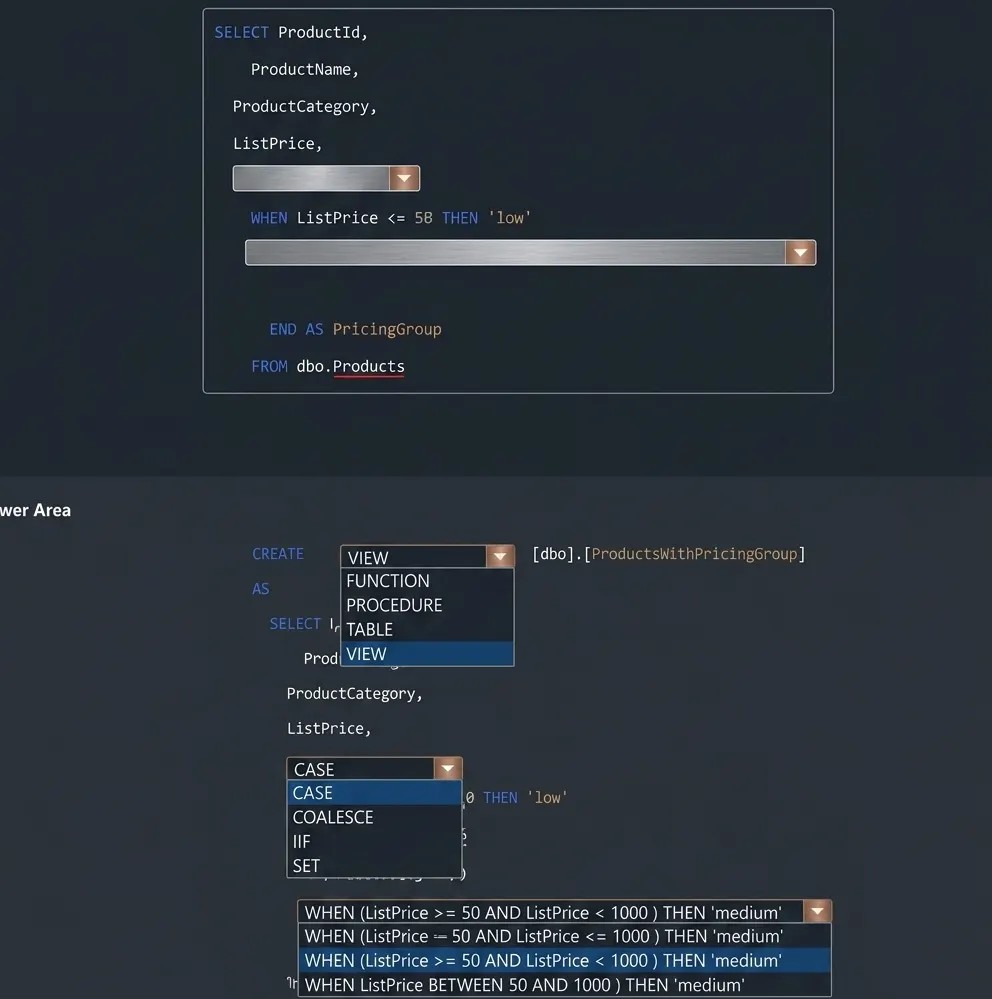
Drag & DropYou need to resolve the issue with the pricing group classification.
How should you complete the T-SQL statement? To answer, select the appropriate options in the
answer area.
NOTE: Each correct selection is worth one point.Show Answer & Explanation Hide Answer & Explanation
Correct Answer
Explanation
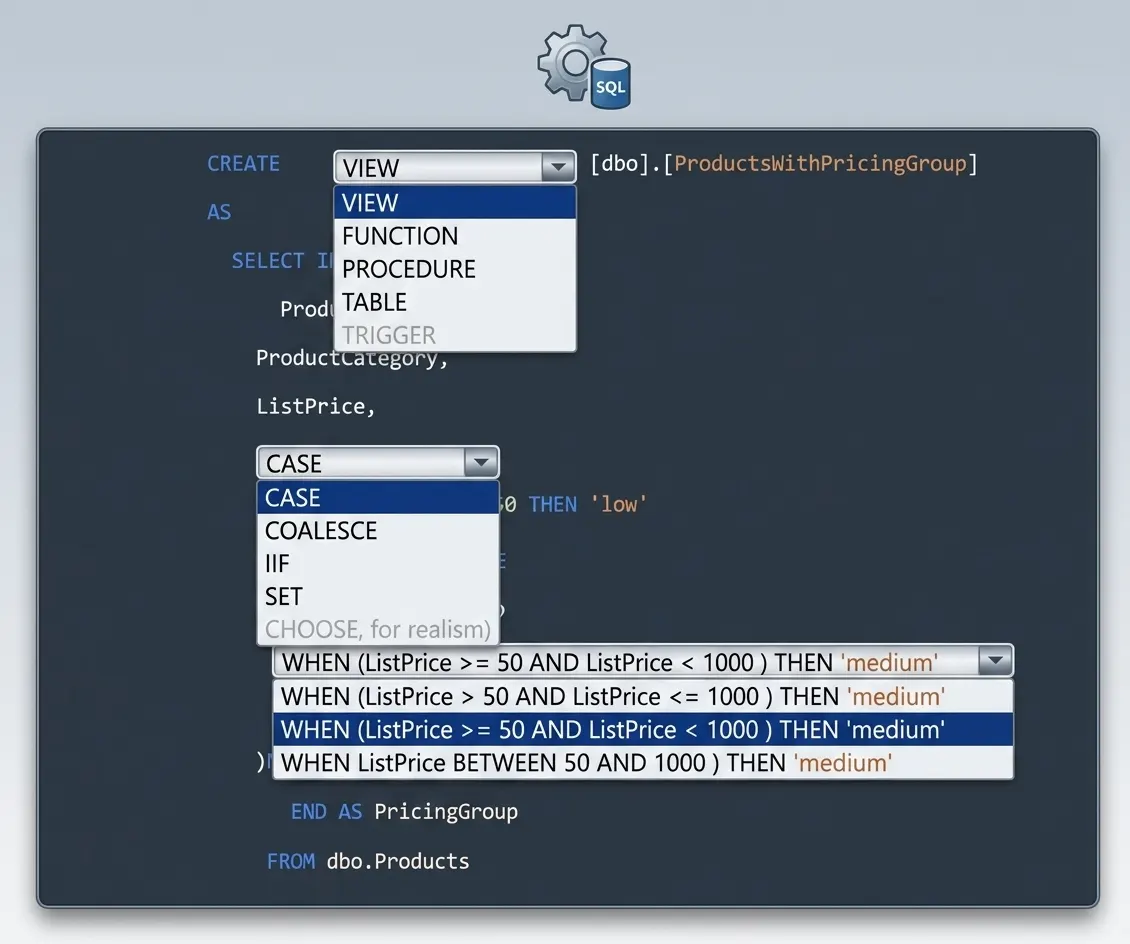
You should use CREATE VIEW to make the pricing group logic available for T-SQL queries.
The CASE statement should be used to determine the pricing group based on the list price.
The T-SQL statement should create a view that classifies products into pricing groups based on the
list price. The CASE statement is the correct conditional logic to assign each product to the
appropriate pricing group. This view will standardize the pricing group logic across different
databases and semantic models. -
Question 4
Drag & DropHOTSPOT
You to need assign permissions for the data store in the AnalyticsPOC workspace. The solution must
meet the security requirements.
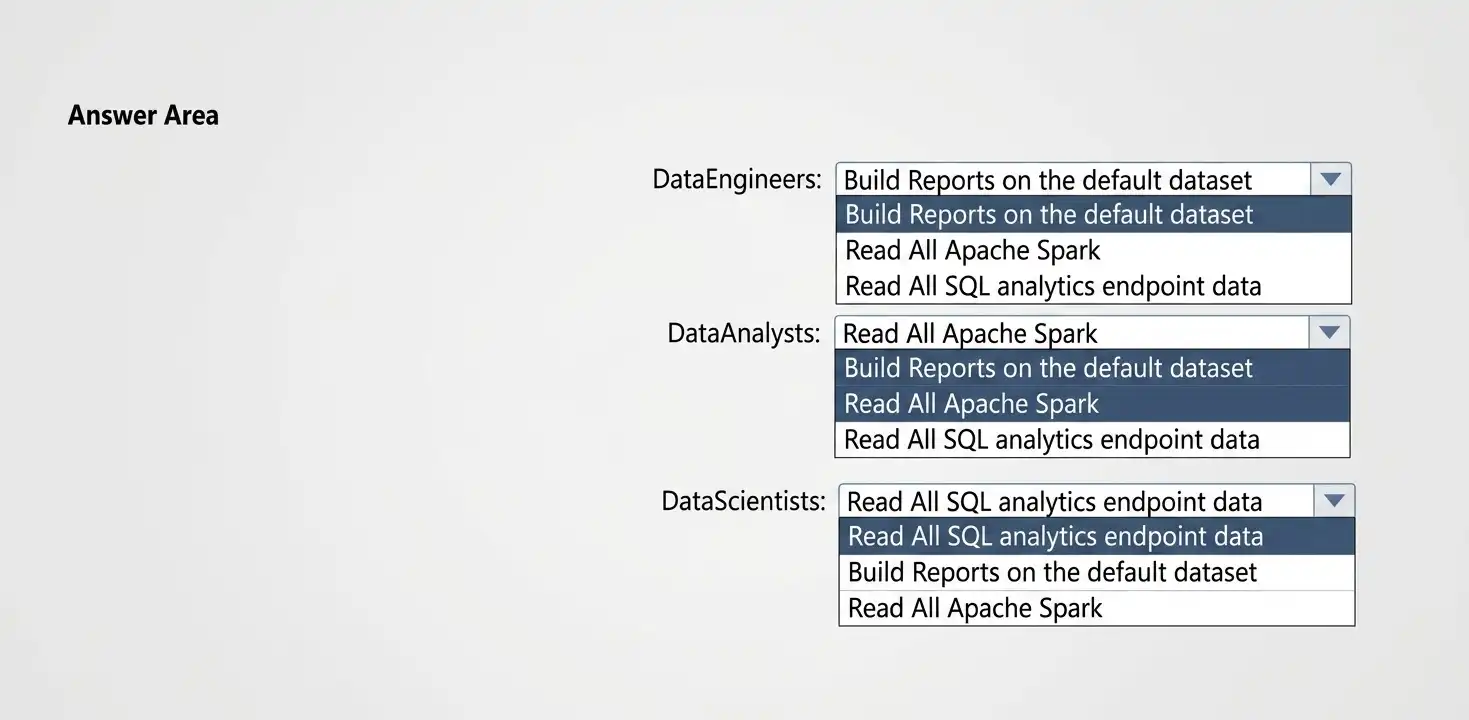
Which additional permissions should you assign when you share the data store? To answer, select the
appropriate options in the answer area.
NOTE: Each correct selection is worth one point.Show Answer & Explanation Hide Answer & Explanation
Correct Answer
Explanation
Data Engineers: Read All SQL analytics endpoint data
Data Analysts: Read All Apache Spark The permissions for the data store in the AnalyticsPOC workspace should align with the principle of
least privilege:
Data Engineers need read and write access but not to datasets or reports.
Data Analysts require read access specifically to the dimensional model objects and the ability to
create Power BI reports.
Data Scientists need read access via Spark notebooks. These settings ensure each role has the
necessary permissions to fulfill their responsibilities without exceeding their required access level.