
Exam Overview
| Exam Code | AI-102 |
| Exam Name | Microsoft Designing and Implementing a Microsoft Azure AI Solution |
| Vendor | Microsoft |
| Total Questions | 381 |
| Last Updated | 26-Oct, 2026 |
Why CertsPoint?
- Latest & Verified Questions
- Detailed Explanations
- Regular Updates
- Full-Length Practice Tests
- Boost Your Exam Confidence
PDF Study Materials
Downloadable guides and resources
Practice Tests
Full-length tests with real exam experience
Progress Tracking
Monitor your performance and improvement
Study Anywhere
Access on desktop, tablet, and mobile
Secure Payment
Privacy Protected
Money Back Guarantee
Free AI-102 Practice Questions
Explore 5 free practice questions for the Microsoft AI-102 exam and review the answers and explanations to support your preparation.
-
Question 1
Drag & DropHOTSPOT
You are developing the shopping on-the-go project.
You are configuring access to the QnA Maker resources.
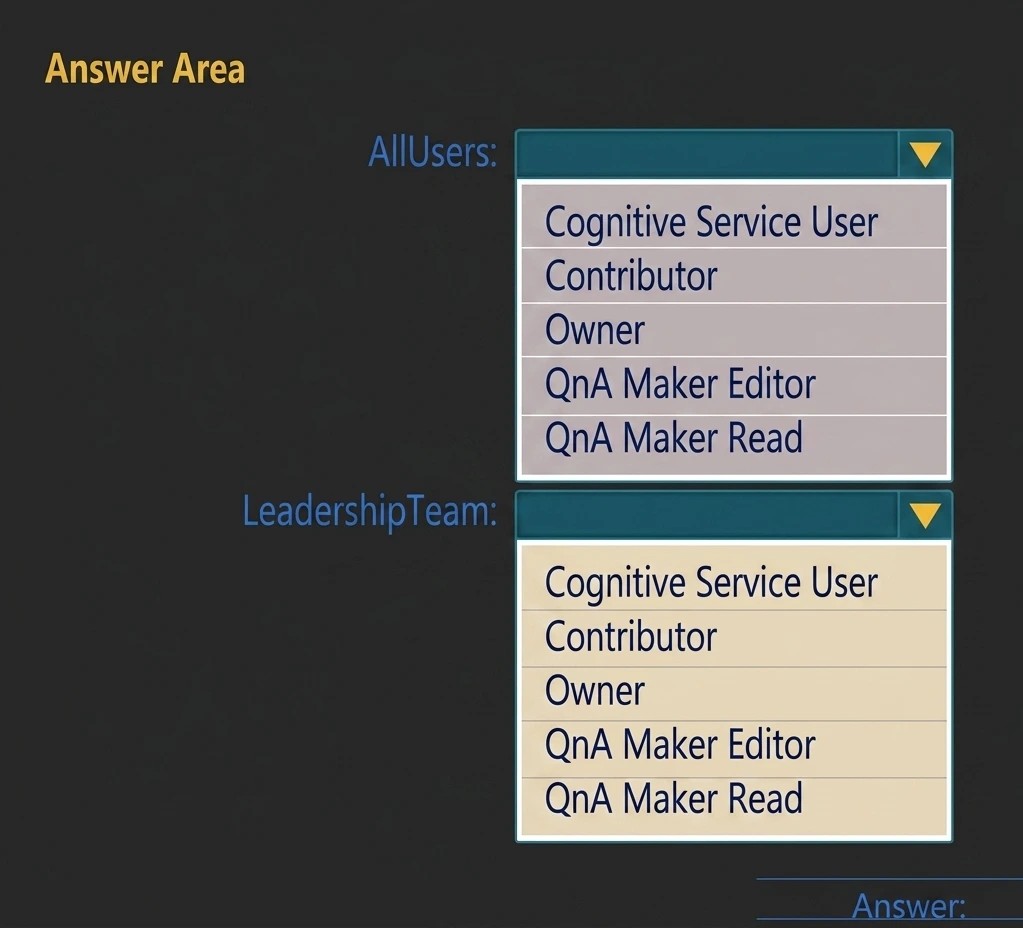
Which role should you assign to AllUsers and LeadershipTeam? To answer, select the appropriate
options in the answer area.
NOTE: Each correct selection is worth one point.Show Answer & Explanation Hide Answer & Explanation
Correct Answer
Explanation
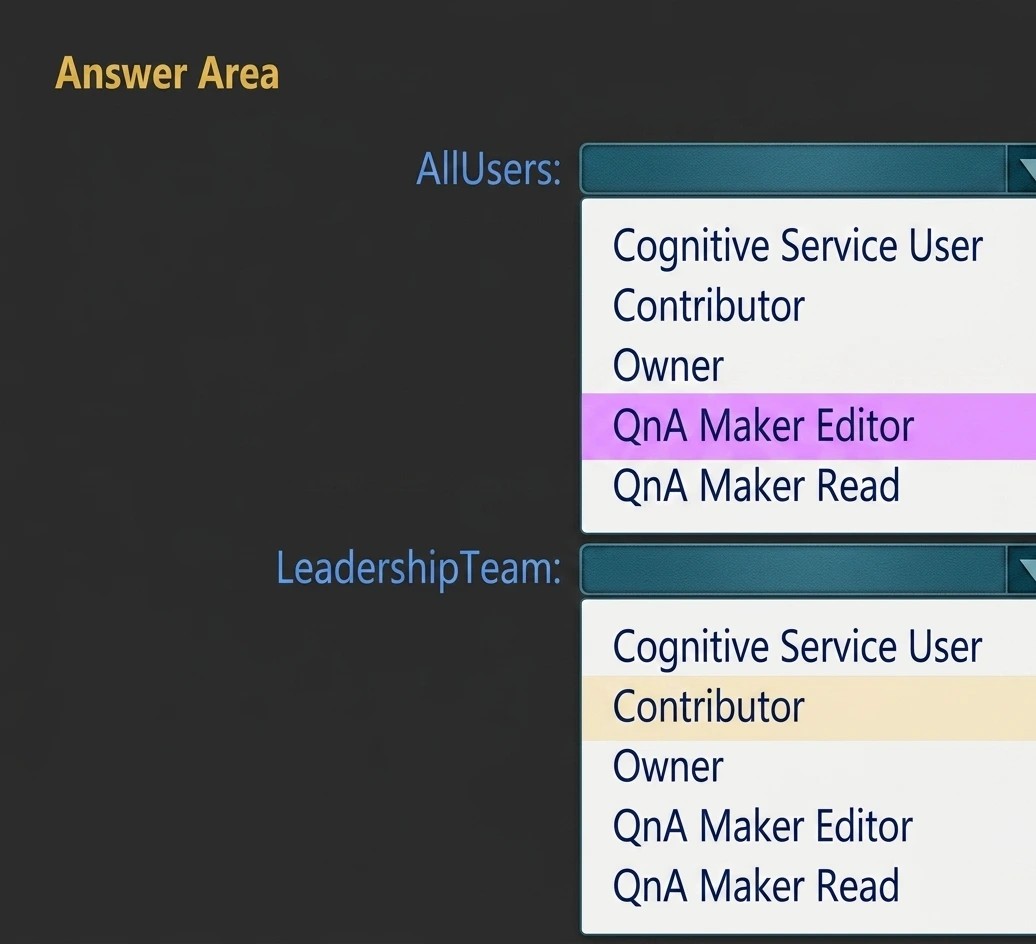
Box 1: QnA Maker Editor
Scenario: Provide all employees with the ability to edit Q&As.
The QnA Maker Editor (read/write) has the following permissions:
Create KB API
Update KB API
Replace KB API
Replace Alterations
"Train API" [in
new service model v5]
Box 2: Contributor
Scenario: Only senior managers must be able to publish updates.
Contributor permission: All except ability to add new members to roles
Reference:
https://docs.microsoft.com/en-us/azure/cognitive-services/qnamaker/reference-role-based-accesscontrol
Page 9 -
Question 2
Multiple answersYou are developing the smart e-commerce project.
You need to implement autocompletion as part of the Cognitive Search solution.
Which three actions should you perform? Each correct answer presents part of the solution. (Choose
three.)
NOTE: Each correct selection is worth one point.-
Option A:Correct
Make API queries to the autocomplete endpoint and include suggesterName in the body.
-
Option B:Correct
Add a suggester that has the three product name fields as source fields.
-
Option C:Correct
Make API queries to the search endpoint and include the product name fields in the searchFields
query parameter. -
Option D:Correct
Add a suggester for each of the three product name fields.
-
Option E:Correct
Set the searchAnalyzer property for the three product name variants.
-
Option F:Correct
Set the analyzer property for the three product name variants.
Show Answer & Explanation Hide Answer & Explanation
Correct Answer: A, B, E, F
Explanation
Scenario: Support autocompletion and autosuggestion based on all product name variants.
A: Call a suggester-enabled query, in the form of a Suggestion request or Autocomplete request,
using an API. API usage is illustrated in the following call to the Autocomplete REST API.
POST /indexes/myxboxgames/docs/autocomplete?search&api-version=2020-06-30
{
"search": "minecraf",
"suggesterName": "sg"
}
B: In Azure Cognitive Search, typeahead or "search-as-you-type" is enabled through a suggester. A
suggester provides a list of fields that undergo additional tokenization, generating prefix sequences
to support matches on partial terms. For example, a suggester that includes a City field with a value
for "Seattle" will have prefix combinations of "sea", "seat", "seatt", and "seattl" to support
typeahead.
F. Use the default standard Lucene analyzer ("analyzer": null) or a language analyzer (for example,
"analyzer": "en.Microsoft") on the field.
Reference:
https://docs.microsoft.com/en-us/azure/search/index-add-suggesters -
-
Question 3
Drag & DropYou are planning the product creation project.
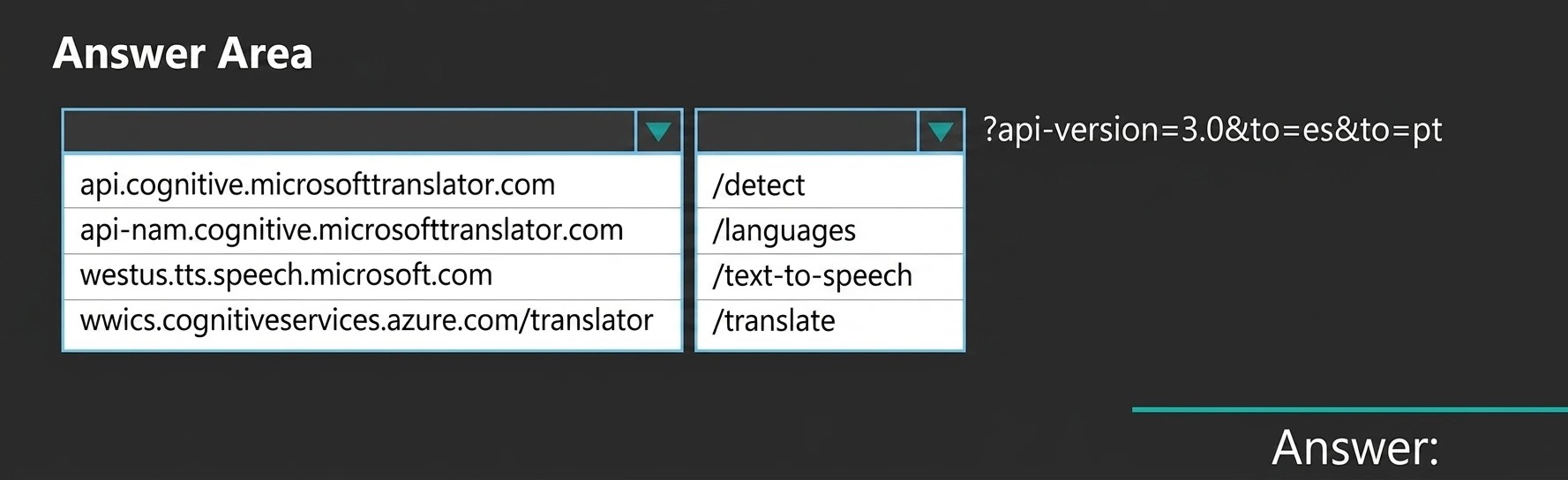
You need to build the REST endpoint to create the multilingual product descriptions.
How should you complete the URI? To answer, select the appropriate options in the answer area.
NOTE: Each correct selection is worth one point.Show Answer & Explanation Hide Answer & Explanation
Correct Answer
Explanation
Box 1: api-nam.cognitive.microsofttranslator.com
https://docs.microsoft.com/en-us/azure/cognitive-services/translator/reference/v3-0-reference
Box 2: /translate
Reference:
https://docs.microsoft.com/en-us/azure/cognitive-services/translator/reference/v3-0-translate -
Question 4
Drag & DropDRAG DROP
You are planning the product creation project.
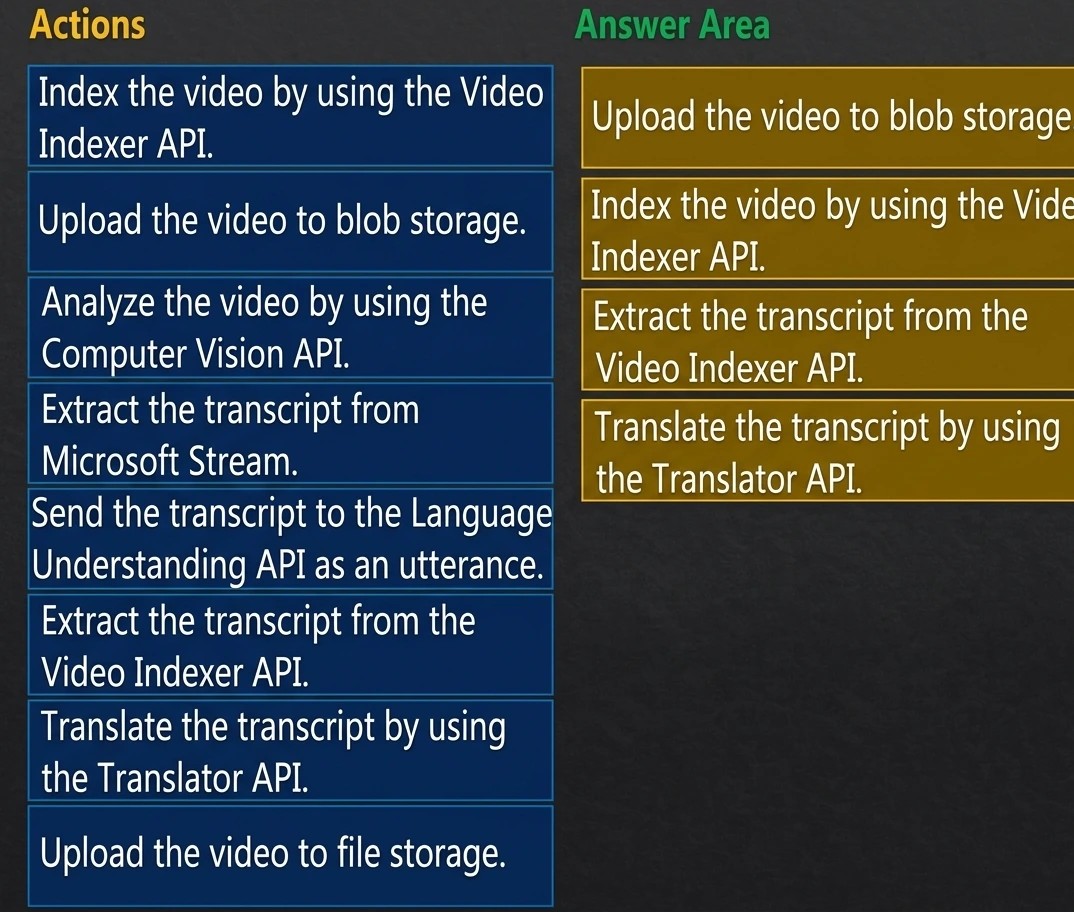
You need to recommend a process for analyzing videos.
Which four actions should you perform in sequence? To answer, move the appropriate actions from
the list of actions to the answer area and arrange them in the correct order. (Choose four.)Show Answer & Explanation Hide Answer & Explanation
Correct Answer
Explanation
Scenario: All videos must have transcripts that are associated to the video and included in product
descriptions.
Product descriptions, transcripts, and all text must be available in English, Spanish, and Portuguese.
Step 1: Upload the video to blob storage
Given a video or audio file, the file is first dropped into a Blob Storage. T
Step 2: Index the video by using the Video Indexer API.
When a video is indexed, Video Indexer produces the JSON content that contains details of the
specified video insights. The insights include: transcripts, OCRs, faces, topics, blocks, etc.
Step 3: Extract the transcript from the Video Indexer API.
Step 4: Translate the transcript by using the Translator API. -
Question 5
Drag & DropDRAG DROP
You are developing the smart e-commerce project.
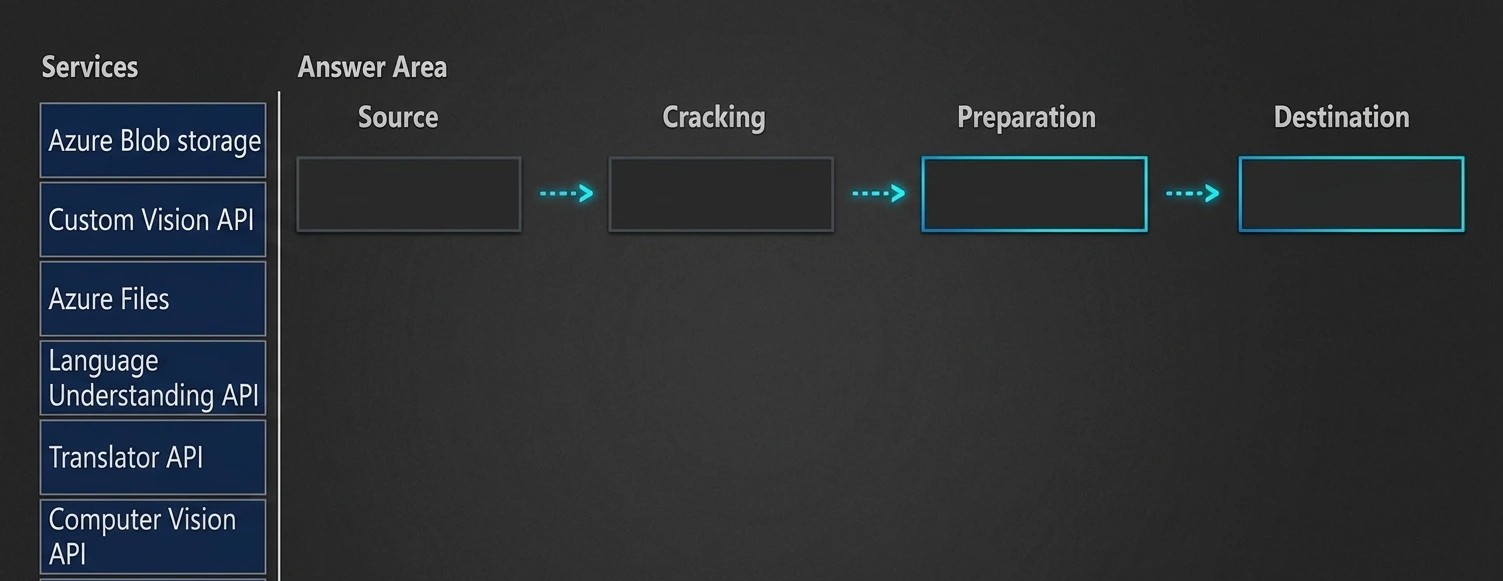
You need to design the skillset to include the contents of PDFs in searches.
How should you complete the skillset design diagram? To answer, drag the appropriate services to
the correct stages. Each service may be used once, more than once, or not at all. You may need to
drag the split bar between panes or scroll to view content.Show Answer & Explanation Hide Answer & Explanation
Correct Answer
Explanation

Box 1: Azure Blob storage
At the start of the pipeline, you have unstructured text or non-text content (such as images, scanned
documents, or JPEG files). Data must exist in an Azure data storage service that can be accessed by an
indexer.
Box 2: Computer Vision API
Scenario: Provide users with the ability to search insight gained from the images, manuals, and
videos associated with the products.
The Computer Vision Read API is Azure's latest OCR technology (learn what's new) that extracts
printed text (in several languages), handwritten text (English only), digits, and currency symbols from
images and multi-page PDF documents.
Box 3: Translator API
Scenario: Product descriptions, transcripts, and all text must be available in English, Spanish, and
Portuguese.
Box 4: Azure Files
Scenario: Store all raw insight data that was generated, so the data can be processed later.
Incorrect Answers:
The custom vision API from Microsoft Azure learns to recognize specific content in imagery and
becomes smarter with training and time.