
| Exam Code | AI-103 |
| Exam Name | Developing AI Apps and Agents on Azure |
| Vendor | Microsoft |
| Total Questions | 96 |
| Last Updated | 26-Oct, 2026 |
- Latest & Verified Questions
- Detailed Explanations
- Regular Updates
- Full-Length Practice Tests
- Boost Your Exam Confidence
PDF Study Materials
Downloadable guides and resources
Practice Tests
Full-length tests with real exam experience
Progress Tracking
Monitor your performance and improvement
Study Anywhere
Access on desktop, tablet, and mobile
Free AI-103 Practice Questions
Explore 9 free practice questions for the Microsoft AI-103 exam and review the answers and explanations to support your preparation.
-
Question 1
Single answerYou have a Microsoft Foundry project that contains a high-traffic agent.
After a recent update, operational costs increase significantly.
Monitoring confirms that the volume of user traffic to the agent remains unchanged.
You suspect that changes to the request or response characteristics are causing the increase.
You need to identify whether the additional costs are driven by the model input size, the model output size, or expanded tool usage.
Which observability capability should you use?
-
Option A:Correct
evaluation metrics
-
Option B:Correct
token usage
-
Option C:Correct
latency
-
Option D:Correct
run success rate
Show Answer & Explanation Hide Answer & Explanation
Correct Answer: B
Explanation
The correct capability is token usage. In Microsoft Foundry observability, token consumption is the primary signal for diagnosing model-cost changes when request volume is unchanged. Token usage lets you distinguish whether costs increased because prompts became larger, retrieved or tool-provided context expanded, responses became longer, or agent execution added more model calls. Microsoft Foundry monitoring dashboards track operational metrics such as token consumption, latency, error rates, and quality scores, and the agent monitoring dashboard is specifically intended to help analyze token usage, latency, success rates, and evaluation outcomes for production traffic.
This directly matches the scenario because the issue is not more traffic, but changed request or response characteristics. Input tokens reveal whether the prompt, chat history, grounding data, or tool outputs being sent to the model increased. Output tokens reveal whether the model is generating longer completions. Expanded tool usage can also increase cost indirectly by adding more tool results, intermediate calls, and context into subsequent model requests; Foundry tracing and observability capture tool usage and token consumption for agent runs.
Evaluation metrics assess response quality and safety, not cost drivers. Latency identifies performance delays, and run success rate measures reliability. Reference topics: Microsoft Foundry observability, agent monitoring dashboard, token consumption, cost analysis, tool usage, and production monitoring.
-
-
Question 2
Single answerYou have an application that processes scanned PDF invoices. The invoices have varied layouts and include multipage tables.
You have a pipeline that uses optical character recognition (OCR) and extracts totals and invoice numbers. The results are often incorrect because the document structure is ignored.
You need to implement a solution that provides OCR, layout analysis, and template-generalizing field extraction. The solution must NOT require training a custom model. The solution must minimize administrative effort.
What should you include in the solution?
-
Option A:Correct
an Azure Machine Learning model
-
Option B:Correct
Azure Content Understanding in Foundry Tools
-
Option C:Correct
Azure Language in Foundry Tools
Show Answer & Explanation Hide Answer & Explanation
Correct Answer: B
Explanation
The correct answer is Azure Content Understanding in Foundry Tools. The scenario requires more than basic OCR because scanned invoices have varied layouts and multipage tables. Content Understanding is designed for intelligent document processing and provides OCR, layout detection, table extraction, field extraction, confidence scores, and grounding in a managed service. Microsoft describes Content Understanding as a service that transforms unstructured content into structured outputs and supports invoice processing by extracting and validating fields from complex documents.
This also meets the requirement to avoid training a custom model. Content Understanding includes prebuilt and domain-specific analyzers, including invoice and procurement-style document processing, and Microsoft states that these analyzers provide structured extraction without custom training. It generalizes across visual template variations by using semantic document categories rather than requiring separate models per invoice layout.
Azure Machine Learning would increase administrative effort because it requires model development, training, deployment, and monitoring. Azure Language is optimized for text analytics tasks such as classification and entity extraction after text is available, but it does not provide document layout analysis or multipage table structure extraction. Reference topics: Content Understanding, intelligent document processing, OCR, layout analysis, analyzers, field schemas, and structured extraction.
-
-
Question 3
Single answerYou are planning a Microsoft Foundry project named Project1 that will contain multiple agents. Each agent will access the same Azure AI Search resource.
You need to recommend a solution to centrally manage the Azure AI Search credentials within Project1. The solution must be implemented across all the agents.
What should you recommend?
-
Option A:Correct
Enable role-based access control (RBAC) for the Azure AI Search resource.
-
Option B:Correct
Disable key-based access control on the Azure AI Search resource.
-
Option C:Correct
Add a connection to the Azure AI Search resource.
-
Option D:Correct
Create a managed private endpoint that connects to the Azure AI Search resource.
Show Answer & Explanation Hide Answer & Explanation
Correct Answer: C
-
-
Question 4
True / FalseNote: This section contains one or more sets of questions with the same scenario and problem. Each question presents a unique solution to the problem. You must determine whether the solution meets the stated goals. More than one solution in the set might solve the problem. It is also possible that none of the solutions in the set solve the problem.
After you answer a question in this section, you will NOT be able to return. As a result, these questions do not appear on the Review Screen.
You have a Microsoft Foundry project that contains an agent. The agent generates summaries from retrieved policy documents.
Users report that some responses omit required regulatory clauses, even when the clauses are present in the retrieved content.
You need to improve response completeness.
Solution: You increase the value of the max_tokens parameter.
Does this meet the goal?
-
Option A: TrueCorrect
-
Option B: FalseCorrect
Show Answer & Explanation Hide Answer & Explanation
Correct Answer: B
Explanation
The solution does not meet the goal. Increasing max_tokens only raises the maximum number of tokens the model is allowed to generate. Microsoft's Azure OpenAI reference defines max_tokens as the maximum number of tokens allowed for the generated answer, and the quota guidance notes that increasing it can help when responses are being truncated.
In this scenario, the problem is not described as output truncation. The required regulatory clauses are already present in the retrieved policy documents, but the agent omits them during summarization. That is a response completeness issue: Microsoft Foundry RAG evaluator guidance defines response completeness as the recall aspect of the response, meaning the response should not miss critical information compared with expected content or ground truth.
A larger token budget might permit a longer answer, but it does not force the model to identify, verify, or include each mandatory clause. It can also increase cost and latency. The appropriate control is a reflection or completeness verification pass that checks the draft against the retrieved policy clauses and regenerates or revises the response when required content is missing. Reference topics: RAG response completeness, model output limits, max_tokens, reflection, and response validation.
-
-
Question 5
Single answerYou have a Microsoft Foundry project that contains an agent.
You need to process mixed-format documents that contain scanned text, tables, and multicolumn layouts. The extracted content must preserve the document structure and be converted into the Markdown format for downstream reasoning.
What should you configure first?
-
Option A:Correct
an Azure OpenAl Responses API call that uses a multimodal model
-
Option B:Correct
an Azure Language in Foundry Tools text analysis model deployment
-
Option C:Correct
a generative chat completion request
-
Option D:Correct
an Azure Content Understanding in Foundry Tools analyzer
Show Answer & Explanation Hide Answer & Explanation
Correct Answer: D
Explanation
The correct answer is A. an Azure Content Understanding in Foundry Tools analyzer. In Azure Content Understanding, an analyzer is the reusable configuration that defines what content type is processed, which elements are extracted, and how the output is structured. Microsoft's analyzer guidance states that analyzers define extraction for text, layout, tables, fields, and output formats such as Markdown and JSON. This makes the analyzer the first required configuration step before downstream reasoning or agent orchestration can use the extracted content.
This matches the requirement because the documents contain scanned text, tables, and multicolumn layouts. Content Understanding document analysis is designed to transform unstructured documents into structured, machine-readable output while preserving document structures and relationships. Its Markdown representation converts unstructured documents into GitHub Flavored Markdown while maintaining content and layout for downstream use.
A generative chat completion request or Azure OpenAI Responses API call could reason over extracted content, but it is not the correct first step for OCR, layout preservation, and Markdown conversion. Azure Language focuses on text analysis after content has already been extracted. Reference topics: Content Understanding analyzers, document extraction, OCR, layout analysis, Markdown output, and downstream reasoning.
-
-
Question 6
Single answerYou have a Microsoft Foundry project that generates product marketing images from text prompts.
After publishing several images, the legal team at your company identifies a competitor's logo on a sign in the background of an image.
You need to remove only the logo, while preserving the rest of the image.
What should you do?
-
Option A:Correct
Rerun the prompt by using a different random seed.
-
Option B:Correct
Apply a mask-based inpainting edit to the part of the image that contains the logo.
-
Option C:Correct
Modify the original prompt to exclude brand names.
-
Option D:Correct
Increase the prompt guidance strength.
Show Answer & Explanation Hide Answer & Explanation
Correct Answer: B
Explanation
The correct answer is C because the requirement is a localized image edit: remove only the competitor logo while preserving the rest of the already generated image. Azure OpenAI image editing is designed for modifying existing images based on a text instruction, rather than regenerating the entire image from scratch. Microsoft's Azure OpenAI image guidance states that the Image Edit API modifies existing images and requires an input image as part of the request. In a mask-based inpainting workflow, the mask identifies the exact region to change, allowing the model to replace only the logo area while retaining surrounding background, composition, lighting, and product content.
Increasing prompt guidance strength would affect adherence during generation, but it would not safely remove a specific logo from a completed image. Modifying the original prompt and regenerating may create a different image and does not guarantee preservation of the approved visual content. Rerunning with a different random seed also changes the image unpredictably and may introduce new brand or legal issues. Mask-based inpainting is the minimal-change remediation method for post-generation brand cleanup. Reference topics: Azure OpenAI image editing, inpainting, mask-guided edits, image generation governance, and computer vision solutions.
-
-
Question 7
Drag & DropHOTSPOT
You have a Microsoft Foundry project that contains a workflow for a customer support triage process.
You have an Ask a question node that stores user responses in a local variable named Var01.
You need to create the following Power Fx expressions:
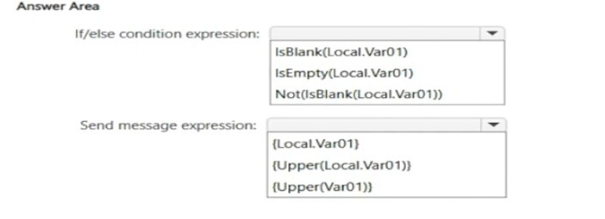
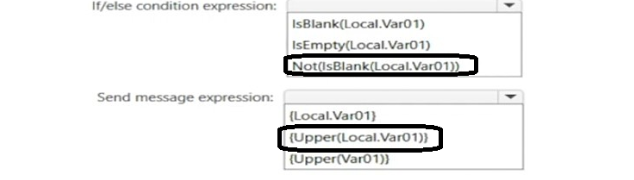
An if/else condition expression that ensures that Var01 contains a value
A Send message expression that returns the stored user response in uppercase
How should you configure the expressions? To answer, select the appropriate options in the answer area.
NOTE: Each correct selection is worth one point.
Show Answer & Explanation Hide Answer & Explanation
Correct Answer
-
Question 8
Single answerYou have a Microsoft Foundry project that contains three agents as shown in the following table.

You need to orchestrate the agents to ensure that the customer requests meet the following requirements:
Support a deterministic, step-based process that uses conditional branching and shared state across the agents.
Optionally trigger a ticket action based on the triage result.
The solution must minimize development effort.
What should you include in the solution?
-
Option A:Correct
a workflow
-
Option B:Correct
threads and runs without a workflow
-
Option C:Correct
a multi-agent group chat session
-
Option D:Correct
separate agent runs coordinated in the application code
Show Answer & Explanation Hide Answer & Explanation
Correct Answer: A
-
-
Question 9
Single answerYou have a Microsoft Foundry project that contains an agent. The agent uses Azure Speech in Foundry Tools.
You fine-tune a baseline speech to text model for the en-us locale and publish the model.
The agent calls the Speech to text REST API and returns an error message indicating that the project ID is invalid.
You need to set the project property to the correct ID.
To what should you set the project property?
-
Option A:Correct
the custom speech endpoint URL
-
Option B:Correct
the custom speech project ID
-
Option C:Correct
the project ID
-
Option D:Correct
the project URL
Show Answer & Explanation Hide Answer & Explanation
Correct Answer: D
-