
Administering Microsoft Azure SQL Solutions DP-300 Exam Questions
Preparing for the DP-300 exam is simple with CertsPoint. We offer easy-to-understand study materials that help you learn the most important exam topics. You can study using our PDF questions, practice online with a real exam-style test, or use the desktop practice software. Choose the study method that works best for you and prepare at your own pace.
At CertsPoint, we keep our DP-300 practice questions up to date. Whenever the exam syllabus or objectives change, we update our study materials so you always learn the latest topics. This helps you save time, avoid outdated content, and feel more confident when you take your exam.
Question #11 (Topic: All Exam Questions)
You create five Azure SQL Database instances on the same logical server.
In each database, you create a user for an Azure Active Directory (Azure AD) user named User1.
User1 attempts to connect to the logical server by using Azure Data Studio and receives a login error.
You need to ensure that when User1 connects to the logical server by using Azure Data Studio, User1
can see all the databases.
What should you do?
Correct Answer: A
Explanation:
Reference:
https://docs.microsoft.com/en-us/azure/azure-sql/database/logins-create-manage
Question #12 (Topic: All Exam Questions)
DRAG DROP
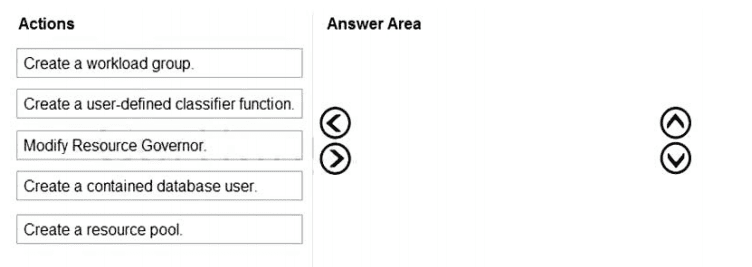
You have an Azure SQL managed instance named SQLMI1 that has Resource Governor enabled and is
used by two apps named App1 and App2.
You need to configure SQLMI1 to limit the CPU and memory resources that can be allocated to App1.
Which four actions should you perform in sequence? To answer, move the appropriate actions from
the list of actions to the answer area and arrange them in the correct order.
A.
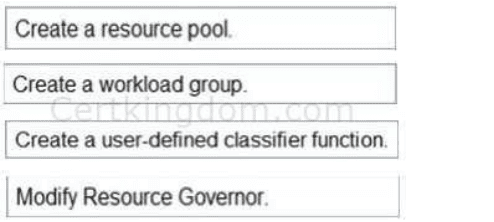
Correct Answer: A
Explanation:
Explanation:
Reference:
https://docs.microsoft.com/en-us/sql/relational-databases/resource-governor/resourcegovernor?
view=sql-server-ver15
https://docs.microsoft.com/en-us/sql/relational-databases/resource-governor/create-and-test-aclassifier
user-defined-function?view=sql-server-ver15
Question #13 (Topic: All Exam Questions)
Note: This question is part of a series of questions that present the same scenario. Each question in
the series contains a unique solution that might meet the stated goals. Some question sets might
have more than one correct solution, while others might not have a correct solution.
After you answer a question in this section, you will NOT be able to return to it. As a result, these
questions will not appear in the review screen.
You have SQL Server 2019 on an Azure virtual machine.
You are troubleshooting performance issues for a query in a SQL Server instance.
To gather more information, you query sys.dm_exec_requests and discover that the wait type is
PAGELATCH_UP and the wait_resource is 2:3:905856.
You need to improve system performance.
Solution: You shrink the transaction log file.
Does this meet the goal?
datab
Correct Answer: B
Explanation:
Explanation:
Reference:
https://docs.microsoft.com/en-US/troubleshoot/sql/performance/recommendations-reduceallocation
contention
Question #14 (Topic: All Exam Questions)
Note: This question is part of a series of questions that present the same scenario. Each question in
the series contains a unique solution that might meet the stated goals. Some question sets might
have more than one correct solution, while others might not have a correct solution.
After you answer a question in this section, you will NOT be able to return to it. As a result, these
questions will not appear in the review screen.
You have SQL Server 2019 on an Azure virtual machine.
You are troubleshooting performance issues for a query in a SQL Server instance.
To gather more information, you query sys.dm_exec_requests and discover that the wait type is
PAGELATCH_UP and the wait_resource is 2:3:905856.
You need to improve system performance.
Solution: You change the data file for the master database to autogrow by 10 percent.
Does this meet the goal?
Correct Answer: B
Explanation:
Reference:
https://docs.microsoft.com/en-US/troubleshoot/sql/performance/recommendations-reduceallocation
contention
Question #15 (Topic: All Exam Questions)
Note: This question is part of a series of questions that present the same scenario. Each question in
the series contains a unique solution that might meet the stated goals. Some question sets might
have more than one correct solution, while others might not have a correct solution.
After you answer a question in this section, you will NOT be able to return to it. As a result, these
questions will not appear in the review screen.
You have SQL Server 2019 on an Azure virtual machine.
You are troubleshooting performance issues for a query in a SQL Server instance.
To gather more information, you query sys.dm_exec_requests and discover that the wait type is
PAGELATCH_UP and the wait_resource is 2:3:905856.
You need to improve system performance.
Solution: You reduce the use of table variables and temporary tables.
Does this meet the goal?
Correct Answer: A
Explanation:
Reference:
https://docs.microsoft.com/en-US/troubleshoot/sql/performance/recommendations-reduceallocation
contention