Exam Overview
| Exam Code | GH-900 |
| Exam Name | Microsoft GitHub Foundations |
| Vendor | Microsoft |
| Total Questions | 124 |
| Last Updated | 26-Oct, 2026 |
Why CertsPoint?
- Latest & Verified Questions
- Detailed Explanations
- Regular Updates
- Full-Length Practice Tests
- Boost Your Exam Confidence
PDF Study Materials
Downloadable guides and resources
Practice Tests
Full-length tests with real exam experience
Progress Tracking
Monitor your performance and improvement
Study Anywhere
Access on desktop, tablet, and mobile
Secure Payment
Privacy Protected
Money Back Guarantee
Free GH-900 Practice Questions
Explore 10 free practice questions for the Microsoft GH-900 exam and review the answers and explanations to support your preparation.
-
Question 1
Single answerWhich of the following is the best GitHub feature for long-form documentation for a project
-
Option A:Correct
Insights
-
Option B:Correct
Pull Requests
-
Option C:Correct
Projects
-
Option D:Correct
Wikis
Show Answer & Explanation Hide Answer & Explanation
Correct Answer: C
Explanation
GitHub offers a variety of features for different aspects of project management and documentation.
For long-form documentation, the best feature is Wikis. Wikis in GitHub allow you to create detailed,
structured documentation that is easy to navigate and edit. Each repository in GitHub can have its
own Wiki, which acts as a space for collaborators to maintain project documentation, guides,
manuals, or any other long-form content. Wikis are specifically designed to host extensive documentation in a way that is easy to reference
and edit over time. They support Markdown, allowing you to format your documentation effectively.
Unlike the other options, Wikis are explicitly intended for the purpose of long-form content, making
them the best choice for this use case. -
-
Question 2
Multiple answersWho can be assigned to an Issue or pull request?
(Each answer presents a complete solution. Choose two.)-
Option A:Correct
Anyone who has an enterprise GitHub account
-
Option B:Correct
Anyone who has commented on the Issue or pull request
-
Option C:Correct
Anyone who has a personal GitHub account
-
Option D:Correct
Anyone with write permissions to the repository
Show Answer & Explanation Hide Answer & Explanation
Correct Answer: B, D
Explanation
In GitHub, issues and pull requests (PRs) are essential tools for managing work and collaboration in a
project. Assigning individuals to these issues or PRs is a way to indicate responsibility for addressing
the issue or completing the PR.
GitHub Docs: Permission Levels for a Repository
GitHub Docs: Assigning Issues and Pull Requests
Anyone with write permissions to the repository:
Anyone who has commented on the Issue or pull request:
Which of the following is the best GitHub feature for long-form documentation for a project?
This detailed explanation provides clarity on GitHub's assignment mechanics for issues and pull
requests, reflecting the platform's collaborative nature.
Users who have write permissions to a repository can be assigned to issues and pull requests. Write
permissions allow users to push changes to the repository, create branches, and modify issues and
pull requests. Assigning them to an issue or PR ensures they are recognized as responsible for the
task.
Option C is incorrect because not all personal GitHub accounts can be assigned to issues or PRs. The
user needs either write permissions to the repository or must have commented on the issue or PR.
Option A is incorrect because having an enterprise GitHub account alone does not necessarily grant
the ability to be assigned to issues or PRs. Permission to assign is based on repository-specific roles
and permissions.
GitHub allows you to assign issues or pull requests to users who have already engaged with the
discussion by commenting on it. This feature is particularly useful for quickly assigning tasks to those
who are already involved in the conversation. -
-
Question 3
Single answerWhat are the defining features of Git?
-
Option A:Correct
Distributed version control, open source software, and being designed for handling projects of any
size with efficiency -
Option B:Correct
Sequential version control, cloud-based hosting service, and being designed for collaboration on
large projects -
Option C:Correct
Low-cost local branching, convenient staging areas, multiple workflows, and being designed for
managing small projects -
Option D:Correct
Centralized version control, proprietary software, and being designed for small projects
Show Answer & Explanation Hide Answer & Explanation
Correct Answer: A
Explanation
Git is a distributed version control system, meaning that every developer has a full copy of the entire
repository, including its history, on their local machine. This enables greater flexibility, as work can be
done offline and each user has access to the full project history.
Open Source Software:
Git is open-source, meaning its source code is freely available for use, modification, and distribution.
This fosters a large community of users and contributors who continuously improve the software.
Option B is incorrect because Git is not a sequential version control system, nor is it inherently tied to
cloud-based services. GitHub, GitLab, and other platforms offer cloud hosting for Git repositories, but
Git itself is a version control tool. Option C is incorrect because Git is not limited to small projects; it is designed to scale efficiently, and
the other features mentioned are only partial descriptions of Git's capabilities. Option D is incorrect because Git is not a centralized version control system; it is distributed.
Additionally, Git is open-source, not proprietary, and is used for projects of all sizes. -
-
Question 4
Single answerWhat is the difference between an organization member and an outside collaborator
-
Option A:Correct
Organization base permissions do not apply to outside collaborators.
-
Option B:Correct
Two-factor authentication (2FA) is not required for outside collaborators
-
Option C:Correct
Outside collaborators cannot be given the admin role on a repository.
-
Option D:Correct
Outside collaborators do not consume paid licenses.
Show Answer & Explanation Hide Answer & Explanation
Correct Answer: A
Explanation
In GitHub, an organization member is a user who has been added to an organization and is subject to
the organization's base permissions and policies. An outside collaborator is a user who is not a
member of the organization but has been granted access to one or more repositories within the
organization. Here’s the difference between an organization member and an outside collaborator:
Organization Members:
Members are subject to the organization's base permissions, which apply across all repositories
within the organization. These permissions might include read, write, or admin access, depending on
what has been set as the default.
Outside collaborators do not have organization-wide permissions. They only have access to specific
repositories to which they have been granted permission. This means organization base permissions
do not apply to them (making option A correct).
Outside collaborators do not consume paid licenses. They are only counted toward the license if they
are made organization members. -
-
Question 5
Multiple answersYou need to configure the queue for telephone-based cases.
What are two possible ways to achieve this goal? Each correct answer presents a complete solution.
NOTE: Each correct selection is worth one point.-
Option A:Correct
Create a case from email.
-
Option B:Correct
Define an SLA and entitlements and set entitlement values for case numbers.
-
Option C:Correct
Configure a status reason transition.
-
Option D:Correct
Create a case routing rule.
-
Option E:Correct
Automatically create or update records.
Show Answer & Explanation Hide Answer & Explanation
Correct Answer: B, C
Explanation
To configure a queue for telephone-based cases in Dynamics 365 Customer Service, you need to ensure proper case handling rules and lifecycle control so cases created from phone calls are processed correctly.
Why B is correct:- Entitlements and SLAs define how cases (including phone-based cases) are prioritized and managed.
- Helps ensure that cases coming from telephone support follow proper service agreements.
- Controls case limits, service levels, and support coverage.
- Status reason transitions control how a case moves between states (Active, On Hold, Resolved, etc.).
- Essential for managing workflow of cases coming from queues like telephone support.
- Ensures cases follow a controlled lifecycle once assigned from the queue.
Why others are incorrect:- A. Create a case from email → Email-specific, not telephone queue configuration.
- D. Create a case routing rule → Useful, but not one of the best answers compared to SLA + status transitions in this scenario.
- E. Automatically create or update records → Generic automation, not specific to queue handling for telephone cases.
-
-
Question 6
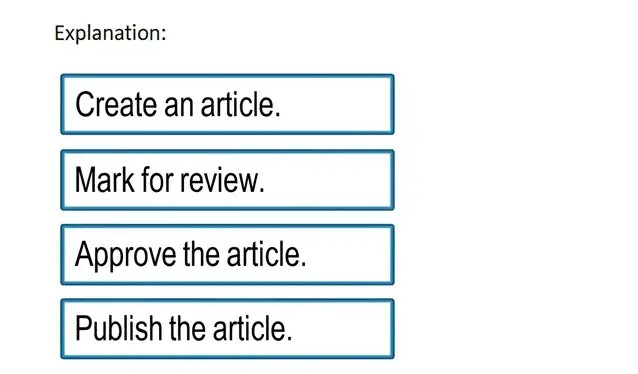
Drag & DropDRAG DROP
You need to configure the system to store answers about claims.
Which four actions should you perform in sequence? To answer, move all actions from the list to the
answer area and arrange them in the correct order.Show Answer & Explanation Hide Answer & Explanation
Correct Answer

Explanation
-
Question 7
Drag & DropDRAG DROP A dispatcher in Indianapolis. Indiana receives an emergency service call on July 4 and assigns the booking to a third-party contractor, attaching the emergency SLA. The contractor receives notification of the work order and travels from his home to the job site, arriving 3.5 hours after the work was assigned. The contractor works for 2 hours, installing 2 new identical chillers, which need to be added to the customer's annual maintenance agreement. The contractor fills in product usage and notes, gets the client's signature, and then changes the booking status to Completed A back office employee needs to look at the work order to ensure accuracy, then change the status to Posted. When performing a quality check, what will the back office employee expect to see as a result of this service call? To answer, drag the appropriate record type to the correct statement. Each record type may be used once, more than once, or not at all. You may need to drag the split bar between panes or scroll to view content. NOTE: Each correct match is worth one point
Show Answer & Explanation Hide Answer & Explanation
Correct Answer


Explanation

-
Question 8
Single answerYou need to satisfy the founder's requirements for displaying the custom image within the app.
Where should you upload the image?-
Option A:Correct
An image column
-
Option B:Correct
A file column
-
Option C:Correct
An icon control
-
Option D:Correct
A web resource
Show Answer & Explanation Hide Answer & Explanation
Correct Answer: D
Explanation
To display a custom image (such as an .svg file) as an icon for a table in a model-driven app, the
image should be uploaded as a web resource in Dynamics 365. Web resources are used to store
images, scripts, and other assets that can be referenced within the application. -
-
Question 9
Multiple answersYou need to ensure the active stage of the business process flow is visible in a view on the Pet table
that you share with the founder.
Which two actions should you perform to meet the founder's requirements? Each correct answer
presents a complete solution. (Choose two.)
NOTE: Each correct selection is worth one point.-
Option A:Correct
Create a new column on the Pet table and use a cloud flow to write the active stage from the
Onboard new pet table to the new column -
Option B:Correct
Create a new column on the Onboard new pet table and use a cloud flow to write the active stage
from the Pet table to the new column. -
Option C:Correct
Using the Active Pets view, edit the columns to add the new columns, save the edited view as a
new view, and then share the view with the owner. -
Option D:Correct
Using the My Pets view, edit the columns to add the new columns, save the edited view as a new
view, and then share the view with the owner.
Show Answer & Explanation Hide Answer & Explanation
Correct Answer: A, C
Explanation
To display the active stage of the business process flow (BPF) in the Pet table view, the active stage
must be stored in a column within the Pet table. Since the Onboard new pet BPF is linked to the Pet
table, a cloud flow can be used to fetch the active stage from the BPF and write it into a newly
created column on the Pet table.
Once the data is available in the Pet table, the next step is to modify an existing view. Since the Active
Pets view is already being used in the system, modifying this view by adding the newly created
column ensures that the relevant data is visible. Saving the edited view as a new one and sharing it
with the founder completes the requirement. -
-
Question 10
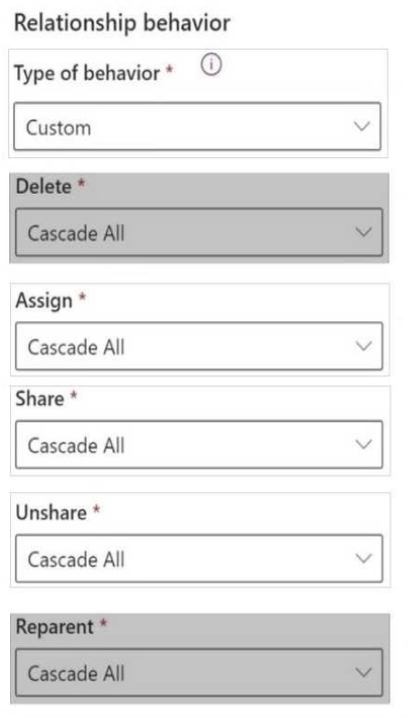
Drag & DropHOTSPOT
You are updating the current relationship behavior of the primary owner (Contact) to pet
relationship.
You need to ensure the case study requirements are met.
Which two options must be changed? To answer, select the appropriate options in the answer area.
NOTE: Each correct selection is worth one point.Show Answer & Explanation Hide Answer & Explanation
Correct Answer

Explanation